
TL;DR:
- Finding parts at Greek tractorshops offers farmers quick access to comprehensive inventories of essential components for maintenance and repair. Building strong supplier relationships, ordering in advance, and sourcing wholesale save time and money while reducing downtime during critical seasons. Established shops like Theocharidis provide expert support, deep stock, and reliable service to ensure efficient and safe farm operations.
Finding the right parts for your tractor in Greece does not have to be a frustrating ordeal. Walk into any well-stocked tractorshop and you will find everything from oil filters and bearings to plows, seeders, and hydraulic components, all in one place. The reality is that Greek farmers have access to some of the most complete agricultural machinery inventories in the Balkans. The challenge is knowing how to use them effectively. This guide walks you through what tractorshops actually offer, how to buy smart, and how to keep your equipment running without costly downtime.
Table of Contents
- What a tractorshop offers for tractor maintenance and repair
- How tractorshops improve efficiency and reduce downtime on Greek farms
- Key tractor accessories every Greek farmer should have
- Steps to choose the right tractorshop and order parts confidently
- Common challenges in tractor parts sourcing and how tractorshops solve them
- Why many Greek farmers underestimate the value of established tractorshops
- Explore trusted tractorshop solutions and expert support with Pexlivanidis
- Frequently asked questions
What a tractorshop offers for tractor maintenance and repair
A well-run tractorshop is not just a shelf of filters and bolts. It is a supply chain compressed into one location, built specifically for farmers who cannot afford to wait a week for a part to arrive from a distant warehouse.
Suppliers like Theocharidis A.E.V.E. illustrate this point clearly. Operating since 1985, this operation stocks over 18,000 items across tractor spare parts and agricultural machinery components. That includes everything from routine consumables like air and oil filters to major overhaul components like gearbox parts, clutch kits, and PTO shafts.
Here is a breakdown of the main product categories you should expect from a fully stocked tractorshop:
- Filters (air, oil, fuel, hydraulic): replaced regularly and critical for engine health
- Bearings and seals: wear items that fail silently until they cause serious damage
- Tires and wheels: correct fitment is non-negotiable for field traction and safety
- Hydraulic components: cylinders, hoses, pumps, and couplings for lift systems
- Seeders and planting attachments: essential for seasonal field prep
- Irrigation components: valves, fittings, pipes for water management
- Livestock equipment: feeders, waterers, and housing accessories for mixed farms
- Lighting kits and safety accessories: required for road travel and visibility in low light
When you are learning to identify tractor spare parts before visiting a supplier, you will move faster and avoid ordering errors. Pair that knowledge with a solid tractor maintenance guide and you are already ahead of most farmers who only react when something breaks.
Pro Tip: Before visiting a tractorshop, write down your tractor’s make, model, year, and engine displacement. Cross-reference with your owner’s manual for part numbers. Suppliers can match parts in seconds when you come prepared.
How tractorshops improve efficiency and reduce downtime on Greek farms
Time is the asset most farmers undervalue. A tractor sitting idle during wheat harvest or olive season is not just inconvenient. It is directly costing you money per hour. This is where a structured relationship with a tractorshop pays off far beyond the parts themselves.
Here is how to build that relationship into your maintenance routine:
- Plan your service calendar at the start of each season. Identify every scheduled service interval for your tractors and compile a parts list before you need them urgently.
- Place bulk orders for consumables. Filters, belts, and spark plugs are predictable expenses. Buying them in volume from a wholesale supplier locks in better pricing.
- Visit or call your tractorshop before peak periods. Stock levels shift quickly before harvest season. Confirm availability for critical parts in April and September at minimum.
- Keep a small buffer stock on your farm. Air filters, hydraulic fluid, and a spare set of belts cost very little to store but can save a full day of downtime.
- Use the supplier’s knowledge. Experienced staff at established shops know which parts fail most often on specific tractor models. Ask them directly.
The numbers support this approach. Picking up from wholesale warehouses in Greece cuts delivery time to one day versus two to three days for standard shipping. Bulk buying filters and bearings for seasonal maintenance saves 20 to 30 percent through negotiated wholesale rates.
“The farmer who prepares in January pays wholesale prices. The farmer who calls in June pays emergency prices and still waits three days.”
Following a reliable seasonal tractor maintenance guide turns this from a theory into a repeatable system. Understanding the preventive maintenance benefits for Greek farmers makes the case even stronger when you are deciding whether to invest upfront in parts or wait until a breakdown forces your hand.
Pro Tip: If your tractorshop offers a wholesale B2B membership, apply for it even if you are a small operation. The pricing tiers often start lower than suppliers advertise, and the staff will prioritize your orders during high-demand periods.
Key tractor accessories every Greek farmer should have
Not every accessory is equal. Some items are purely comfort upgrades. Others directly affect how long your tractor lasts and whether it is safe to operate. Here is how to tell the difference.
The essential tractor accessories list for Greek conditions should cover these core categories:
- Multi-stage air filters: Greek fields generate fine dust that destroys engines. A premium filter extends your service interval and protects the injection system.
- Heavy-duty hydraulic hoses: Olive and citrus groves require frequent loader and implement use. Standard hoses crack under repeated pressure cycling.
- LED work lighting kits: Early morning and late evening work is common during harvest. Proper lighting reduces accidents and improves precision.
- Cab safety equipment: ROPS (rollover protection structures) and seat belts are legally required in Greece. Many older tractors lack compliant setups.
- PTO safety guards: One of the most commonly ignored safety items and one of the most dangerous when missing.
- Tire inflation monitoring: Running underinflated tires on soft or terraced terrain increases soil compaction and fuel consumption simultaneously.
The table below compares accessory categories by impact area, so you can prioritize purchases based on your specific operation:
| Accessory | Primary benefit | Replacement frequency | Cost priority |
|---|---|---|---|
| Air and oil filters | Engine protection | Every 250-500 hours | High |
| Hydraulic hoses | Implement reliability | Every 2-3 seasons | High |
| LED lighting kits | Safety and visibility | 5+ years | Medium |
| PTO safety guards | Operator safety | As needed/damaged | Critical |
| Tire pressure systems | Fuel efficiency | One-time install | Medium |
| Cab insulation kits | Operator comfort | Every 5+ years | Low |
Theocharidis experts stress that a well-organized catalog covers everything from routine filters to major overhauls, keeping performance consistent year-round. That means you should not need to source from multiple suppliers for different categories. One reliable tractorshop should handle your full accessory list.
Steps to choose the right tractorshop and order parts confidently
Not all suppliers are created equal. A shop with a broad catalog but slow response and poor staff knowledge will cost you more than a smaller shop that knows exactly what you need. Here is a practical framework for evaluating your options.
- Check years in operation. A supplier with 10 or more years in the agricultural sector has seen enough tractor models and seasonal demands to stock intelligently. Operations like Theocharidis, operating since 1985 with robust wholesale supply across Greece, have the track record to back their product claims.
- Confirm inventory depth, not just breadth. Ask if they carry parts for your specific tractor brand. A shop listing 20 categories but stocking only two units per SKU will disappoint you on the first urgent order.
- Verify delivery options. Can they ship to your area within one business day? Do they offer warehouse pickup? These logistics questions matter more in May than in December.
- Test the staff’s knowledge. Call with a specific part number or a symptom description and evaluate whether the response is helpful or generic. Experienced staff will ask clarifying questions.
- Understand their return and exchange policy. Wrong parts happen. A supplier who makes exchanges easy is worth paying a slight premium for.
When you are choosing tractor accessories for a specific model, match the part number from your manual before confirming any order. Cross-referencing across manufacturer catalogs is standard practice at good shops but never assume they will do it for you automatically.
Your agricultural machinery maintenance guide should list every component by service interval. Bring that list to your supplier so they can flag any items that are difficult to source and advise on stocking ahead.
Pro Tip: Ask your tractorshop for a printout of their most commonly ordered parts for your tractor brand. This list often reveals maintenance items you had not yet considered but should be monitoring.
Common challenges in tractor parts sourcing and how tractorshops solve them
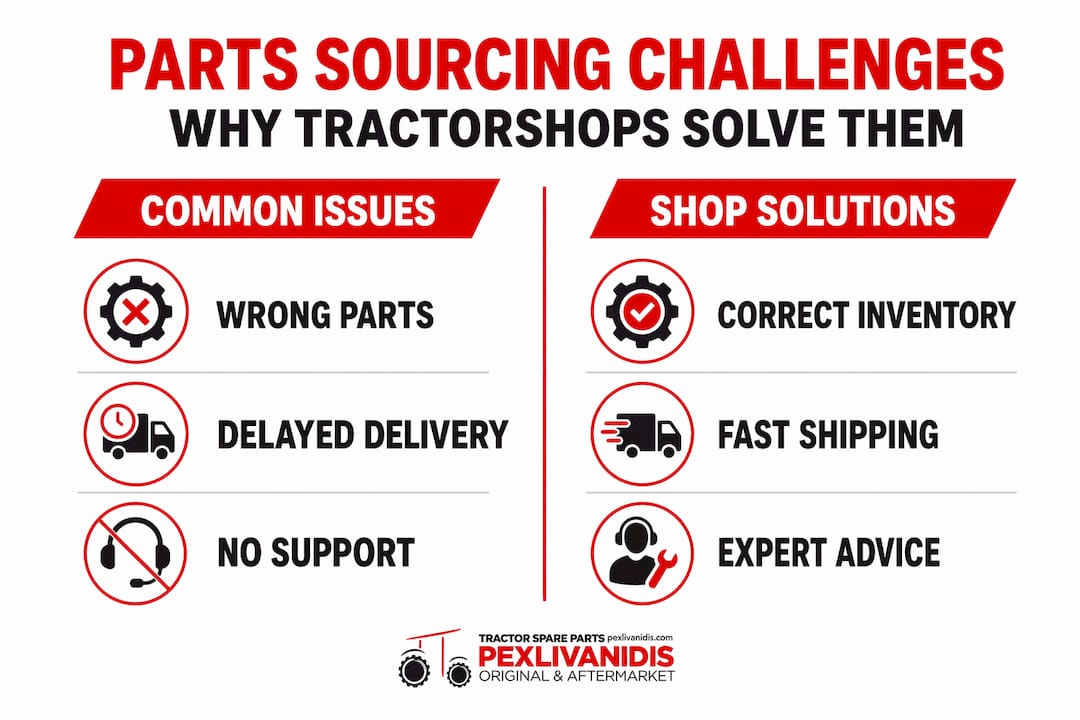
Greek farmers running older tractor models face a specific sourcing problem: parts that were standard in 1995 are now considered legacy stock, and generic online platforms rarely carry them in sufficient depth. A specialized tractorshop with a mature inventory solves this in ways that general e-commerce cannot.
The most frequent problems farmers report when sourcing parts include:
- Long delivery times from general online retailers: Standard shipping from outside Greece often takes five to ten days, which is unacceptable during harvest.
- Counterfeit or substandard components: Non-certified bearings and filters can fail within weeks, causing secondary damage far more expensive than the original repair.
- Lack of model-specific advice: Ordering from a catalog without expert guidance leads to wrong fitment and wasted returns.
- Incompatible components: Even genuine parts from the correct brand can be wrong if the model year or production run changed specifications mid-series.
“A counterfeit filter does not fail on purchase day. It fails at the worst possible moment, 200 hours later, during peak season.”
A tractorshop with a deep inventory solves these problems structurally. The 18,000+ item catalog of a supplier like Theocharidis assures comprehensive availability, helping farmers avoid downtime and costly delays even for older or less common tractor models.
The process of ordering machinery parts online from a trusted agricultural machinery shop is safer and faster than most farmers assume, provided you use a supplier with proper cataloging, part number verification, and staff support built into the transaction process.
Why many Greek farmers underestimate the value of established tractorshops
Here is the uncomfortable pattern we see repeatedly. A farmer saves 15 euros on a filter by ordering from an unknown seller online. That filter fails three months later and ruins a fuel injection pump worth 600 euros. The 15-euro saving cost roughly 585 euros net, plus two days of downtime.
This is not a rare edge case. It is a predictable outcome of prioritizing unit price over supply chain quality.
The appeal of informal or anonymous suppliers is real. They are cheaper upfront, they are available on marketplaces at any hour, and the order feels straightforward. But the total cost of ownership calculation almost always favors established tractorshops over a three-to-five-year horizon.
Wholesale buying from reputable suppliers saves 20 to 30 percent versus standard online alternatives while offering far better parts traceability and next-day availability. These are not small advantages. On a farm running three tractors with quarterly maintenance schedules, the annual savings compound quickly.
Established tractorshops also carry something no online marketplace can replicate: institutional knowledge. A supplier who has been matching parts to Greek tractor fleets for 30 or 40 years knows which components fail in the heat of a Thessaloniki summer, which bearings corrode in coastal Kavala humidity, and which filter brands have declined in quality over the past decade. That advice, given freely at the counter, is worth more than any loyalty discount.
For guidance on accessing wholesale tractor parts pricing and what to look for when evaluating supplier credibility, the difference between a transactional purchase and a long-term parts relationship starts with the questions you ask before you order anything.
Explore trusted tractorshop solutions and expert support with Pexlivanidis
To support your tractorshop journey, Pexlivanidis provides detailed resources and product solutions built specifically for Greek farmers and agricultural machinery operators. From 7 essential agricultural machinery parts explained in plain language to a complete agricultural machinery maintenance guide covering service intervals and component selection, you will find the guidance you need to maintain your equipment with confidence. Need help with setup after purchase? The tractor accessory installation guide walks you through correct fitment for optimal results. With over 20,000 items in inventory, free shipping on orders above 100 euros across Greece, and wholesale B2B options for serious operators, Pexlivanidis is equipped to serve farmers in Thessaloniki, Kavala, and across the region.
Frequently asked questions
What types of tractor parts can I find at a tractorshop in Greece?
You can find a wide range including filters, bearings, seeders, plows, irrigation components, and livestock equipment. Established suppliers like Theocharidis A.E.V.E. stock over 18,000 items of tractor spare parts and agricultural machinery components accumulated since 1985.
How can buying parts wholesale from a tractorshop save me money?
Wholesale buying from tractorshops reduces delivery time significantly and can save 20 to 30 percent through negotiated rates, especially when purchasing seasonal maintenance items like filters and bearings in bulk.
What should I consider when choosing a tractorshop in Greece?
Prioritize suppliers with long-standing operation, a deep inventory for your specific tractor brand, fast delivery options, and knowledgeable staff. Theocharidis A.E.V.E. operates since 1985 with robust wholesale supply and a broad product range as a reference benchmark.
Are tractorshops reliable for urgent tractor repairs?
Yes. Tractorshops with wholesale warehouses in Greece can reduce delivery times to as little as one day versus two to three days for standard shipping, making them the most practical option when a breakdown occurs during peak season.
Can tractorshops help me choose the correct accessories for my tractor?
Yes. Reputable tractorshops offer expert advice and complete catalogs to match accessories to your specific model. Theocharidis experts stress their catalog covers everything from routine filters to major overhauls, supporting peak performance year-round.