

TL;DR:
- Reliable spare parts suppliers ensure quick delivery, accurate fit, and technical support to prevent costly downtime.
- Official dealers offer extensive stock and manufacturer-trained support, while independents excel in niche or less common brands.
- Evaluating supplier responsiveness, inventory transparency, and return policies helps farmers build trustworthy partnerships.
One broken hydraulic seal. One missing bearing. One unavailable filter. That’s all it takes to bring an entire harvest operation to a grinding halt for days. Greek farmers know this pressure well: machinery failure at peak season doesn’t just cost repair time, it costs yields, contracts, and income. Yet many operators still choose their spare parts supplier the way they pick fuel stops, by proximity and habit rather than proven reliability. This guide cuts through the guesswork and gives you concrete, data-backed criteria to identify suppliers who will actually deliver when it counts most.
Table of Contents
- Why reliability matters in spare parts supply
- Types of spare parts suppliers: Official dealers vs. independents
- How to evaluate a supplier’s reliability in practice
- Technical support: The hidden advantage of reliable suppliers
- Checklist: Applying reliability criteria to your next supplier
- Our perspective: What most advice skips about parts supplier reliability
- Upgrade your farm’s reliability with trusted suppliers
- Frequently asked questions
Key Takeaways
| Point | Details |
|---|---|
| Supplier reliability affects farm profits | Choosing trusted suppliers cuts machinery downtime and costly delays. |
| Official dealers maximize support | They provide deep stock, fast support, and consistent parts accuracy. |
| Always vet suppliers’ performance | Check reviews, technical support, and stock before purchasing tractor parts. |
| Technical support saves time | Expert guidance prevents errors and speeds up repairs on Greek farms. |
Why reliability matters in spare parts supply
Farm machinery doesn’t break on a schedule. A tractor that fails during plowing or a combine that stalls mid-harvest creates a cascade of problems that ripple far beyond the repair itself. Lost time in critical growth or harvest windows translates directly to lost revenue, and in Greek agriculture, where seasonal windows are tight and weather unpredictable, a two-day wait for a spare part can mean a week’s work gone.
The financial stakes are real. Consider these direct impacts of unreliable part sourcing:
- Delayed deliveries force you to rent equipment or hire external labor at premium rates.
- Wrong-fit parts waste money on returns and extend downtime even further.
- No technical guidance means misdiagnosis, leading to ordering the wrong component entirely.
- Limited stock at a supplier causes multi-stop sourcing that multiplies your lost time.
Supplier reliability isn’t a soft metric. It’s tied directly to machinery uptime, which is tied directly to farm revenue. The quality spare parts benefits you gain from a trusted source include not just correct components but also faster resolution cycles when something goes wrong.
“Every day of downtime during harvest season is a day that cannot be recovered. Farmers cannot afford to gamble on unverified suppliers when the cost is measured in lost crops, not just repair bills.”
That’s why inventory depth matters so much. Over 200,000 spare part codes stocked by suppliers like Agrotech SA show what immediate availability actually looks like at scale. That level of stock isn’t vanity. It’s the practical difference between a same-day fix and a week-long wait.
For Greek farms operating across diverse terrain and with mixed machinery fleets, partnering with suppliers who carry broad, deep inventories is not a luxury. It’s sound operational strategy. With the importance of reliable parts clear, let’s examine the types of suppliers you’ll encounter in Greece.
Types of spare parts suppliers: Official dealers vs. independents
Not all suppliers operate the same way, and understanding the difference can save you both money and headaches. In Greece, the spare parts market breaks into two broad categories: official dealers tied to major manufacturers, and independent specialists who work across brands.
| Feature | Official dealers | Independent specialists |
|---|---|---|
| Stock depth | Very high | Moderate to high |
| Brand coverage | Single or few brands | Multi-brand or niche |
| Technical support | Manufacturer-trained | Experience-based |
| Pricing | Higher | Competitive to lower |
| Aftersales support | Structured | Variable |
| Speed for rare parts | May lag on niche items | Often faster |
Official dealers are your safest bet for common, high-volume machinery like John Deere or New Holland. Official dealers like Agrotech for John Deere offer the highest reliability through massive stock and manufacturer-level technical support. The tradeoff is price: premium service comes at premium cost.
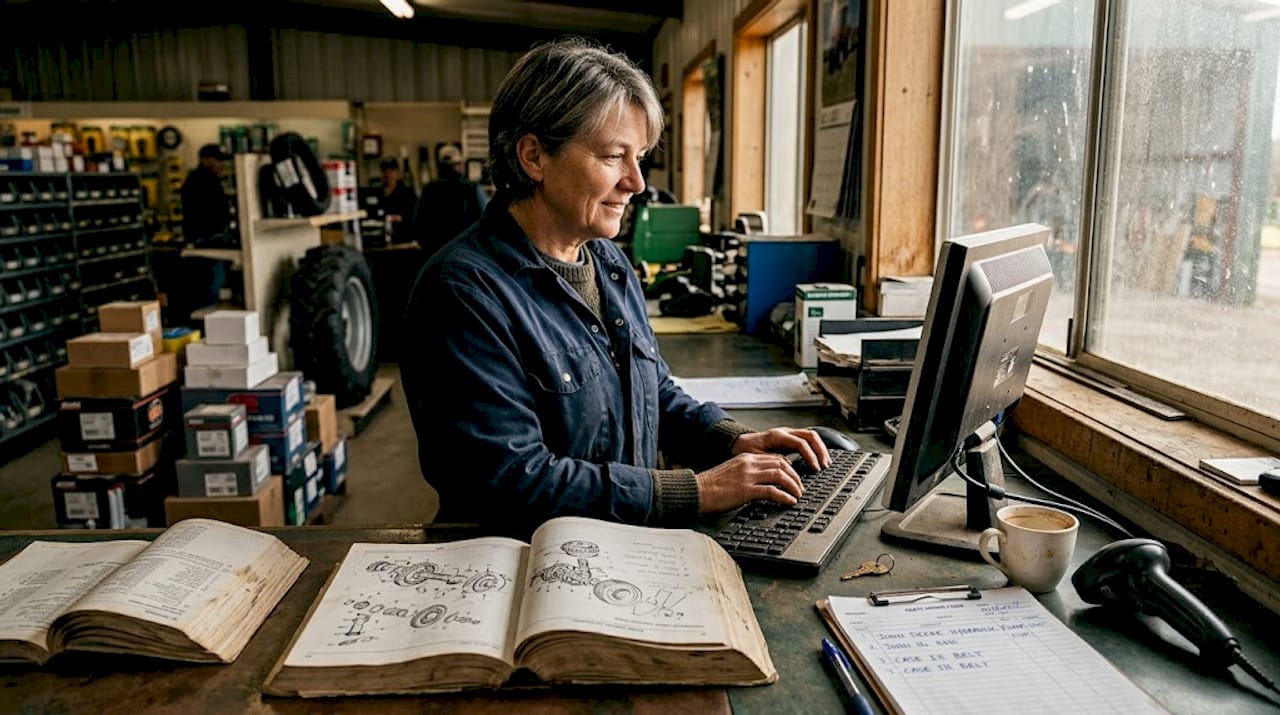
Independents fill a different role. They can be faster and more flexible, especially for brands that official Greek dealers don’t heavily stock. Paouris Parts excels for niche Japanese brands with strong customer satisfaction, showing that independent specialists can genuinely outperform official channels for specific machinery categories.
Here’s what to look for regardless of supplier type:
- Response speed: Does the supplier answer inquiries promptly, or do you wait days for a quote?
- Fit accuracy: Are parts listed with detailed specs, or just generic descriptions?
- Aftersales support: Can you return a part that doesn’t fit, and how fast will they resolve it?
Pro Tip: Before committing to any supplier, send a test inquiry about a specific part with your tractor model and serial number. How fast and how accurately they respond tells you everything about their actual service capability.
For a deeper look at choosing between manufacturer-original and aftermarket components, the OEM spare parts guide walks through the key tradeoffs. You should also understand OEM in machinery impact before making a final supplier choice. Both options fit particular needs, but how can you tell if a supplier, dealer or independent, will deliver when it counts?
How to evaluate a supplier’s reliability in practice
Knowing the theory is one thing. Applying it to a real supplier decision is another. Here’s a step-by-step approach that experienced Greek operators actually use.
- Check inventory breadth: Does the supplier list parts with real-time availability, or just show “available upon request”? Serious suppliers publish what they have in stock.
- Read customer reviews carefully: Look for comments on fit accuracy and shipping speed, not just star ratings. Paouris Parts scores 4.3/5 on Trustpilot with 127 positive local reviews, a benchmark worth using when evaluating competitors.
- Evaluate technical inquiry response: Call or email with a specific part number and ask a fitting question. A reliable supplier answers clearly and quickly.
- Assess return policies: A supplier confident in their parts offers a clear return window for non-fitting components without drama.
- Ask about shipping timelines: Same-day or next-day dispatch is realistic for quality suppliers. Vague delivery estimates are a red flag.
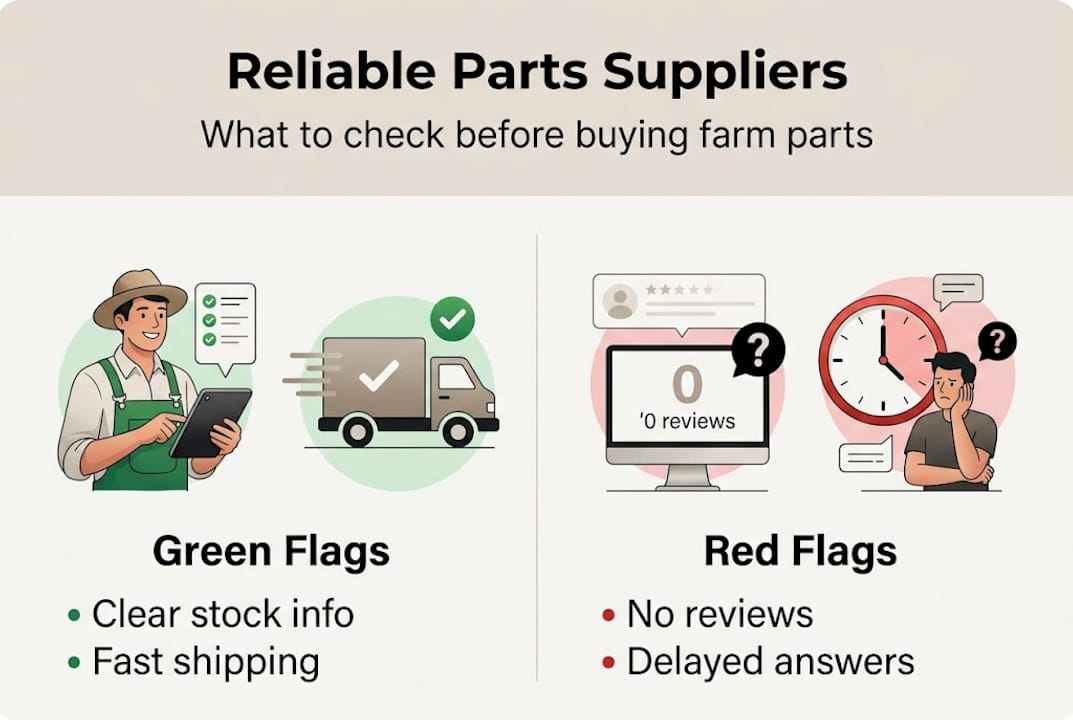
| Reliability signal | Green flag | Red flag |
|---|---|---|
| Stock information | Real-time availability listed | “Contact us for availability” |
| Customer reviews | Detailed, recent, multi-platform | None or anonymous only |
| Technical support | Named experts, fast response | Generic form submissions |
| Return policy | Clear terms, easy process | Vague or absent |
| Shipping | Defined timeline, tracking | “Estimated delivery” only |
Document your findings for each supplier you evaluate. This builds a reference sheet for future emergencies when you don’t have time to research from scratch. The OEM tractor parts benefits resource can help you set the quality baseline before you start comparing suppliers.
Pro Tip: Keep a shortlist of two or three vetted suppliers for each machinery brand you operate. When a breakdown happens mid-harvest, you need answers in minutes, not hours spent searching.
Reliability often comes with added service. Let’s explore the value of technical support that official and specialized suppliers can offer.
Technical support: The hidden advantage of reliable suppliers
Most farmers focus on price and delivery speed when comparing suppliers. Technical support rarely makes the shortlist. That’s a mistake, and it’s often an expensive one.
Ordering the wrong part is more common than most operators admit. A seal that’s 2mm off spec won’t seal. A filter with the wrong thread pitch won’t seat. These errors don’t just waste money on the part itself. They waste the labor time of installation, the delay in reordering, and the continued downtime of your machinery.
Here’s what genuine technical support from a reliable supplier actually provides:
- Correct part identification using your tractor’s model, year, and serial number.
- Compatibility confirmation before you order, not after the part arrives.
- Troubleshooting guidance that might resolve the issue without a new part at all.
- Installation tips for parts that have common fitting errors.
“Access to manufacturer-trained technical staff is not a premium add-on. It is a core component of supplier reliability that directly reduces total repair cost and downtime.”
Official dealers offer technical consultation that ensures correct part selection and provides troubleshooting help, which is a measurable advantage during high-pressure harvest windows. Specialists like HIGAS and Agrotech train their staff on specific machinery lines, meaning you reach someone who genuinely knows your equipment.
For Greek operators managing older or multi-brand fleets, this matters even more. Parts cross-referencing across model years requires expertise that a generalist supplier simply doesn’t have. Explore what farm machinery technical support looks like in practice, and understand the role of technical support in reducing long-term operational costs.
Pro Tip: Always ask a supplier if they have technical staff available during your operating hours. A supplier whose support team closes at 2pm is not a reliable partner for harvest-season emergencies.
With this understanding of reliability and support, here’s how you can apply these criteria to your next supplier decision.
Checklist: Applying reliability criteria to your next supplier
Use this checklist every time you consider a new spare parts supplier. It takes less than 30 minutes and can save you days of downtime.
- Stock check: Search for your specific part on their website. Is real-time availability shown? If you have to call just to find out if something is in stock, that’s already a friction point.
- Review scan: Search the supplier name plus reviews on Google, Trustpilot, and agricultural forums. Look specifically for mentions of shipping speed, fit accuracy, and communication. Fast shipping, exact fit, and excellent service are the three pillars consistently highlighted by satisfied customers.
- Technical inquiry test: Contact their support with a specific question about your machinery. Measure response time and accuracy.
- Aftersales support check: Read their return and warranty policy. If it’s buried in fine print or absent, proceed with caution.
- Return policy review: Confirm they accept returns on non-fitting parts within a reasonable window, at least 14 to 30 days.
- Document supplier performance: After each purchase, note delivery time, part fit, communication quality, and any issues. This record becomes invaluable when you need to make a fast decision during a breakdown.
- Identify a backup: Always maintain at least one secondary vetted supplier for each machinery brand you run. Single-source dependency is a risk that costs Greek farmers real money every season.
This process isn’t bureaucratic. It’s a practical investment that pays off the moment your tractor fails at 6am on the first day of harvest.
Our perspective: What most advice skips about parts supplier reliability
Here’s the uncomfortable truth: most Greek farmers settle for whatever supplier is nearby or familiar, and they only discover the real cost of that decision when they’re staring at a broken machine with no parts available and a field that needs working.
Conventional advice focuses on price comparisons and brand recognition. What it misses is that why OEM spare parts matter is only half the story. The other half is supplier performance over time. A parts relationship that works in calm months can collapse completely during the three critical weeks of harvest when every supplier is under pressure.
The operators who consistently avoid costly downtime are not the ones who found the cheapest parts. They’re the ones who invested time upfront to vet suppliers, build relationships with technical staff, and maintain backup options. They treat supplier selection the way they treat equipment maintenance: proactively, not reactively.
Tracking supplier performance across seasons isn’t obsessive. It’s simply good farm management. The farmers who skip this step pay for it repeatedly, while those who do it once benefit for years.
Upgrade your farm’s reliability with trusted suppliers
Finding the right spare parts supplier is the first step. Keeping your machinery in peak condition year-round is what follows. At Pexlivanidis, we’ve built a catalog of over 20,000 agricultural parts with free shipping across Greece on orders above 100€, serving farmers in Thessaloniki, Kavala, and beyond. Browse our guides on essential agricultural machinery parts to understand what your fleet actually needs, and use our machinery maintenance tips to reduce the frequency of urgent repairs. When you’re ready to source parts you can trust, our team is available to help you find exactly what fits your equipment.
Frequently asked questions
What’s the main advantage of sourcing tractor parts from an official dealer in Greece?
Official dealers offer the broadest stock and manufacturer-backed technical support, and suppliers like Agrotech SA carry over 200,000 spare part codes for immediate availability, meaning less downtime for Greek farmers.
How can I check if a supplier is truly reliable?
Check real customer reviews for mentions of shipping speed and fit accuracy, verify stock transparency on their site, and test their technical support response before you place your first order. Suppliers like Paouris Parts demonstrate reliability through consistent positive reviews highlighting fast shipping, exact fit, and excellent service.
Is it risky to buy from independent specialist suppliers?
The risk varies by supplier, but many independents offer excellent reliability for niche brands. Paouris Parts excels for niche Japanese tractor brands with strong customer satisfaction as evidence that independent specialists can match or beat official dealers in specific categories.
Does technical support really make a difference when ordering spare parts?
Absolutely. Expert guidance prevents mismatched parts and avoids the cost of returns and extended downtime. Official dealers offer technical consultation that ensures correct part selection and provides troubleshooting help, making technical support a critical factor in your supplier decision.