

TL;DR:
- The TS 125 A is a powerful, purpose-built tractor with unique specs requiring specific maintenance.
- Common issues include overheating, gear wear, and hydraulic problems, which demand regular checks and targeted repairs.
- Reliable parts and detailed service manuals are essential for proper upkeep, best sourced from authorized dealers and trusted suppliers.
Most farmers assume that if you’ve worked with one New Holland TS series tractor, you’ve worked with them all. That assumption costs money. The TS 125 A is a distinct machine with its own specs, quirks, and failure points that generic TS advice doesn’t always cover. Treating it like a TS 110 or TS 115 when you’re ordering parts or diagnosing a problem can send you down a frustrating and expensive path. This guide breaks down exactly what makes the TS 125 A unique, what issues to watch for, and how to keep it running strong through long Greek harvest seasons.
Table of Contents
- Understanding the New Holland TS 125 A: Key specs and features
- Common issues in the TS 125 A and how to address them
- Essential parts and service resources for TS 125 A owners
- Expert tips for extending the life of your TS 125 A
- A practical perspective: What most TS 125 A guides miss
- Where to find expert guidance and parts for your TS 125 A
- Frequently asked questions
Key Takeaways
| Point | Details |
|---|---|
| TS 125 A essentials | Understand unique specs so you always source compatible parts and solutions. |
| Common problems | Proactively address overheating, gear, and fluid issues to reduce downtime. |
| Access right resources | Use genuine manuals and trusted Greek dealers for reliable parts and repairs. |
| Expert maintenance tips | Follow daily and monthly routines for lasting tractor performance. |
| Local expertise matters | Rely on field-proven advice and local supply networks for best results. |
Understanding the New Holland TS 125 A: Key specs and features
With the need for specifics established, let’s break down exactly what makes the TS 125 A unique.
The TS 125 A is not a rebadged version of a lighter model. It’s a purpose-built utility tractor with serious power behind it. Manufactured from 2003 to 2007 in Basildon, England, the TS 125 A delivers 125 HP through a 6.7L 6-cylinder diesel engine. That’s a meaningful step up from the lower TS variants, and it changes how you think about parts compatibility.
The transmission is a 16/24-speed power shift unit, which gives operators flexibility across different terrain and field types. This is especially relevant in Greece, where you might move from flat plains to rolling terrain within a single workday. The hydraulic pump flows up to 26.5 gallons per minute, and the rear lift capacity reaches up to 9,620 lbs. The tractor itself weighs around 11,331 lbs, making it one of the heavier machines in the TS lineup.
Understanding these core numbers is not just trivia. When you’re looking at a TS series tractor overview and comparing part numbers, these specs determine whether a component fits your machine or a lighter variant. A hydraulic seal designed for the TS 75 will not handle the flow rate of the TS 125 A.
Here’s a quick reference table for the most important specs:
| Specification | TS 125 A Value |
|---|---|
| Engine displacement | 6.7L (6-cylinder diesel) |
| Horsepower | 125 HP |
| Transmission | 16/24-speed power shift |
| Hydraulic pump flow | 26.5 gpm |
| Rear lift capacity | 9,620 lbs |
| Operating weight | 11,331 lbs |
| Production period | 2003 to 2007 |
For Greek operators, the features that matter most on a daily basis include:
- Fuel type: Diesel, compatible with standard Greek agricultural diesel supply
- Rear lift capacity: 9,620 lbs supports heavy implements common in grain and cotton farming
- Transmission type: Power shift allows shifting under load without clutching, reducing operator fatigue
- Hydraulic flow: High flow supports dual-circuit implements and front loader use
- Weight distribution: Heavier chassis improves traction in loose or plowed soil
For more on how the TS series engine details compare across variants, it’s worth reviewing the specific displacement and torque figures before ordering any engine-side components.
Common issues in the TS 125 A and how to address them
Now that you know what sets the TS 125 A apart, it’s vital to understand what can go wrong and, more importantly, how to fix it fast.
The TS 125 A shares a platform with other TS models, which means it shares some of their known weak points. Engine overheating, gear wear, and fuel pump issues are documented across the TS series. In the 125 A specifically, the higher engine load makes heat management even more critical.
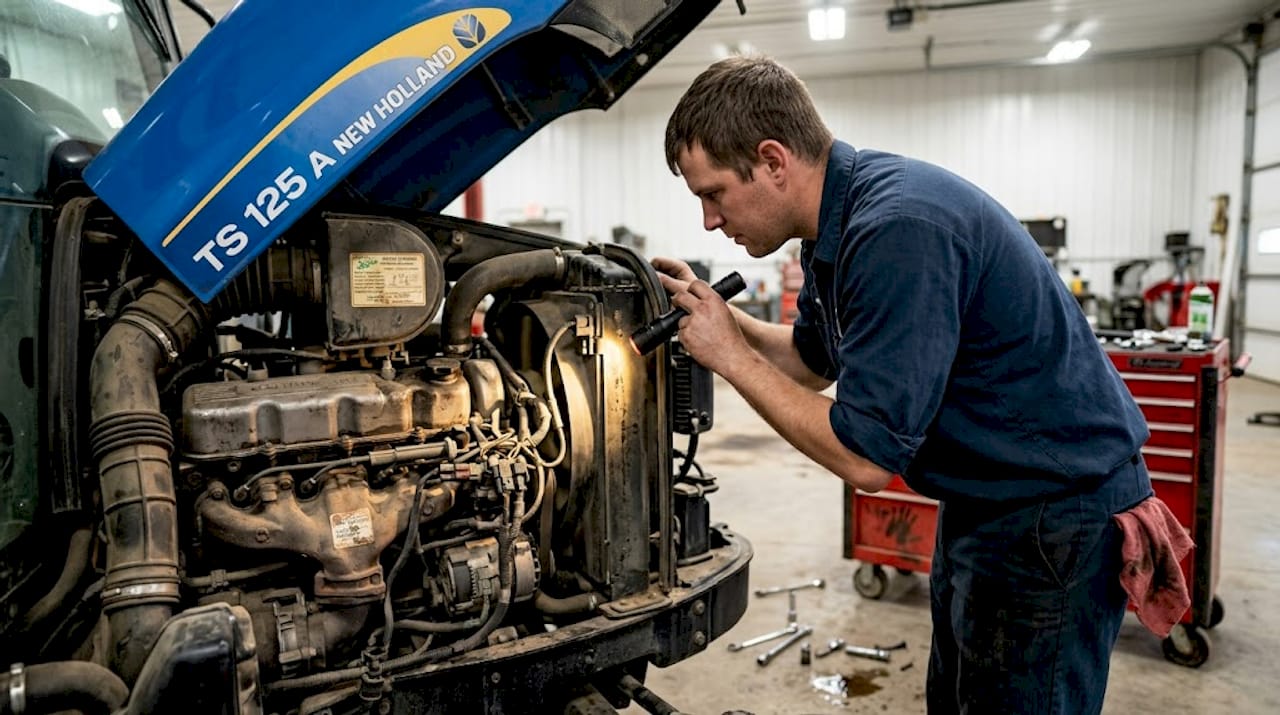
Here’s a quick comparison of the most common symptoms, causes, and interventions:
| Symptom | Likely Cause | Recommended Action |
|---|---|---|
| Engine running hot | Dirty radiator or clogged air filter | Clean radiator fins, replace air filter |
| Gear slippage or noise | Insufficient lubrication | Check and top up transmission oil |
| Fuel delivery lag | Contaminated fuel system | Drain, flush, and replace fuel filter |
| Shuttle shift delays | Low or degraded hydraulic fluid | Check hydraulic fluid level and condition |
| Internal knocking noise | Worn internal components | Inspect and replace worn parts promptly |
To address these issues systematically, follow this sequence when diagnosing a problem:
- Check all fluid levels first, including engine oil, hydraulic fluid, and coolant.
- Inspect the air filter and radiator for visible debris or blockage.
- Test the shuttle shift under light load before attempting field use.
- Listen for knocking or grinding during startup before load is applied.
- Review your maintenance log to identify any overdue service intervals.
Regular hydraulic fluid checks are not optional on the TS 125 A. The power shift transmission depends entirely on clean, correctly leveled fluid to operate without delay or damage. Skipping this check is the single fastest way to turn a minor fluid issue into a major rebuild.
Pro Tip: Set a monthly reminder to lubricate all grease points on the TS 125 A, including front axle pins, lift arm pivot points, and PTO shaft. Consistent lubrication reduces wear on components that are expensive to replace and hard to source quickly. For more structured guidance, see these maintenance tips for tractors and review common tractor repair methods before your next service.
For a broader look at understanding common tractor issues across models, patterns from similar TS series tractors are a useful reference point.
Essential parts and service resources for TS 125 A owners
Once common problems are addressed, sourcing the right parts and documentation is the next critical step.
The first resource every TS 125 A owner should have is the official service manual. A comprehensive repair manual covers the full TS100A through TS135A range, including detailed repair instructions, torque specifications, special tool requirements, and procedures for engine overhaul, transmission work, front axle, cab removal, cooling, and lubrication systems. Having this document on hand before you start any repair saves hours of guesswork.
When it comes to sourcing parts in Greece, you have several reliable options:
- Authorized New Holland dealers: New Holland Greece operates as an official entity with delivery and support activity in the Thessaloniki area. Dealer networks are your best bet for genuine OEM components.
- Regional agricultural supply stores: Thessaloniki and surrounding areas have several specialized agricultural machinery suppliers who stock compatible parts for popular TS series models.
- Online platforms: Reliable e-commerce platforms that specialize in agricultural machinery parts, like Pexlivanidis, offer extensive catalogs with over 20,000 items and free shipping within Greece for orders exceeding 100 euros.
- Cross-reference tools: Use the service manual part numbers to verify compatibility before ordering any component.
One of the most common mistakes operators make is ordering parts based on model name alone without checking the serial number prefix. The TS 125 A uses different component specifications than the TS 115 A or TS 130 A in key areas like the hydraulic pump seal kit and clutch pack assembly.
Pro Tip: Before visiting any Greek dealer or placing an online order, write down your tractor’s serial number, engine hours, and a description of the symptom. Dealers can cross-reference the serial number to confirm part compatibility and flag any known supersessions. This single step prevents returns and delays. Review these tractor maintenance essentials and tractor maintenance steps to build a complete service picture before ordering.
Expert tips for extending the life of your TS 125 A
Having sourced the right tools and manuals, now let’s focus on making your TS 125 A outlast common expectations through proven, real-world tips.
In Greek agricultural conditions, the TS 125 A faces stresses that manufacturers’ manuals only partially anticipate. Dust from dry summer fields, high ambient temperatures in regions like Thessalia and Macedonia, and long continuous operating hours put components under accelerated wear. The tractors that last 10,000 hours or more are the ones with owners who treat maintenance as a daily habit, not a seasonal event.
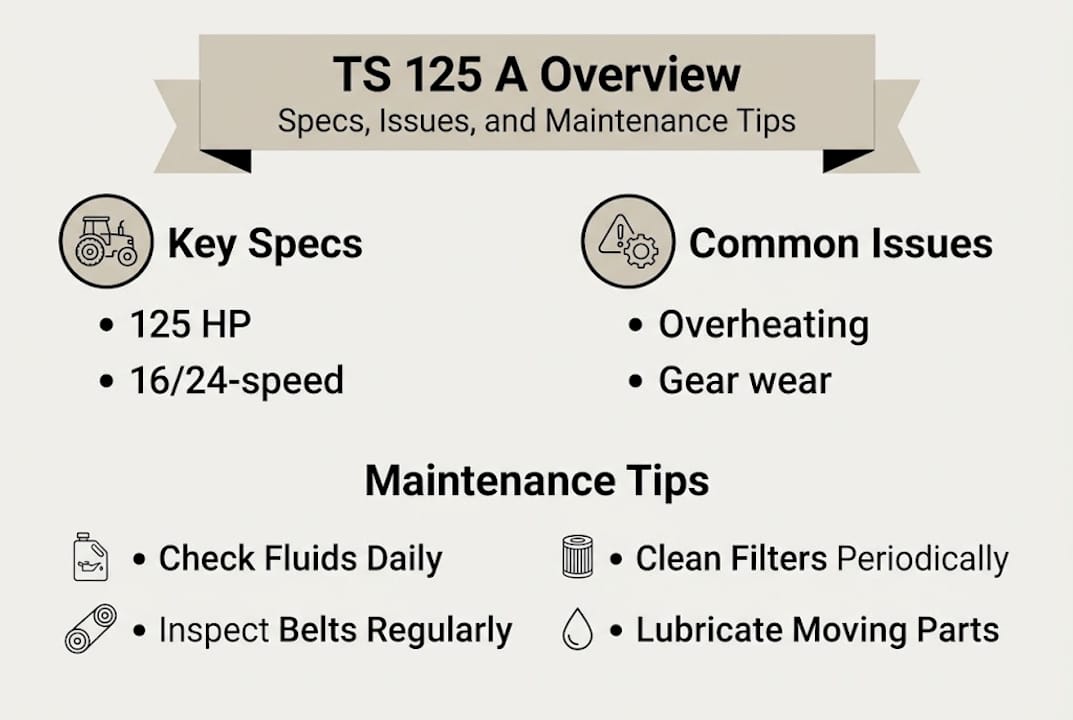
Hydraulic fluid quality and levels are the single biggest factor in preventing shuttle shift failures in power shift transmissions. Regular lubrication is equally critical for reducing gear wear in high-hour tractors.
Here are five daily and monthly checks that make a measurable difference:
- Daily: Check engine oil level before startup. Low oil on a warm start is more damaging than running low mid-day.
- Daily: Inspect the air pre-cleaner bowl and empty if more than half full. Greek summer dust fills this faster than you’d expect.
- Monthly: Change or inspect the hydraulic filter and check fluid condition. Dark or milky fluid signals contamination.
- Monthly: Grease all zerk fittings on the front axle, lift arms, and three-point hitch linkage.
- Monthly: Inspect belts, hoses, and coolant level. Catch a cracked hose before it becomes an overheating event in a remote field.
Scheduled maintenance consistently reduces repair costs by up to 25% compared to reactive servicing on high-hour utility tractors. That’s real money saved over a working season.
Pro Tip: Watch for early warning signs before they escalate. A slight hesitation during shuttle shifting, a small coolant smell after shutdown, or unusual vibration at PTO engagement are all early signals. Address them within a day or two, not a week. Waiting turns a 30-minute fix into a full rebuild. For a structured approach, follow this step-by-step maintenance plan calibrated for working tractors.
A practical perspective: What most TS 125 A guides miss
All the technical guides in the world don’t match what you learn hauling a TS 125 A through a summer season in Thessalia. Most online resources treat the TS series as interchangeable. They’re not.
The 125 A’s power shift transmission is both its biggest advantage and its most demanding system. Generic TS series advice often references lighter-duty procedures that don’t account for the fluid volume and pressure requirements of the 125 A’s hydraulic circuit. Following those instructions to the letter can leave you with components that are slightly under-serviced over thousands of hours.
What we’ve seen in real field situations is that Greek operators who build their own checklists based on actual work cycles, not just manual intervals, consistently outperform those who follow generic schedules. If you’re running the tractor in 40-degree heat for 12 hours a day during harvest, your service intervals should be compressed, not calendar-based.
Local dealer relationships matter more than most guides admit. A dealer in Thessaloniki who knows your machine’s history can flag a part that’s about to fail before you even ask. That kind of institutional knowledge doesn’t appear in any manual. For ongoing advanced maintenance insights, building a relationship with specialists who know the TS 125 A specifically is worth more than any generic guide.
Where to find expert guidance and parts for your TS 125 A
To translate technical insight into real-world reliability, connect with a trusted supplier and local expertise.
At Pexlivanidis, we specialize in agricultural machinery parts with a catalog of over 20,000 items, including components for New Holland tractors like the TS 125 A. Whether you need hydraulic seals, filters, transmission parts, or consumables, our platform is built to get you the right part fast, with free shipping within Greece on orders over 100 euros. Explore our essential agri parts guide to understand what components your TS 125 A needs most, or review our agri maintenance guide for structured service planning. Visit the Pexlivanidis main site to search our full inventory, request part availability, or reach our team directly for expert guidance.
Frequently asked questions
What engine does the TS 125 A New Holland use?
The TS 125 A features a 125 HP, 6.7L diesel 6-cylinder engine built for rugged, continuous use in demanding agricultural conditions.
What are the most common maintenance issues with the TS 125 A?
Frequent problems include engine overheating and gear wear, along with shuttle shift delays caused by low or degraded hydraulic fluid.
Where can I get official service documentation for the TS 125 A?
Service manuals for TS100A-TS135A are available online and include detailed repair procedures, torque specs, and special tool requirements for the full range.
Are parts for the TS 125 A easy to find in Greece?
Yes, genuine parts are typically available through authorized New Holland dealers in Greece, particularly in the Thessaloniki area, and through specialized online platforms.