

TL;DR:
- Many Greek farmers rely on Perkins parts and quality oil, but engine failures often result from procedural mistakes rather than part quality. Following strict maintenance, proper air bleeding, torque control, and correct oil viscosity are essential to ensure engine longevity and performance. Sourcing genuine parts from authorized suppliers and adhering to procedural guidelines significantly reduce breakdowns and repair costs over the engine’s lifespan.
Many farmers in Greece rely on genuine Perkins parts and quality oil, yet their engines still underperform or fail ahead of schedule. The reason is almost never the parts themselves. It is usually a small procedural mistake, an incorrectly bled fuel system, or a pipe fitting torqued just a little too tight or too loose. These errors are invisible until the damage is done. This guide walks you through the maintenance steps, diagnostic methods, and sourcing practices that actually keep Perkins diesel motors working at their best, season after season.
Table of Contents
- Why Perkins diesel motors are trusted in agriculture
- Essential maintenance steps for Perkins diesel motors
- Diagnosing common Perkins engine issues
- When and how to source Perkins diesel motor parts
- The nuanced reality of Perkins motor upkeep: what most guides miss
- Find trusted Perkins diesel motor parts and maintenance support
- Frequently asked questions
Key Takeaways
| Point | Details |
|---|---|
| Follow precise procedures | Strict adherence to air bleeding and torque guidelines prevents common engine issues. |
| Match oil viscosity to climate | Choosing the right oil grade based on Greek weather boosts engine performance and longevity. |
| Diagnose issues systematically | Use engine manual symptom tables to pinpoint problems quickly and accurately. |
| Source genuine Perkins parts | Reliability depends on correct identification and sourcing of engine components using official guides. |
Why Perkins diesel motors are trusted in agriculture
Having previewed practical benefits, let’s drill down into what makes Perkins motors a cornerstone of farm machinery reliability in Greece and across Southern Europe.
Perkins engines have been powering agricultural machinery for decades, and there are very good reasons why so many Greek farmers refuse to switch. Greece’s agricultural landscape is demanding. Olive groves on hillsides, cotton fields under summer heat, and vineyards on rocky terrain all push machinery hard. Perkins diesel motors are built to handle exactly these kinds of variable, high-stress conditions without requiring constant babysitting.
Here is what sets them apart:
- Proven reliability in tough field conditions. Perkins engines are designed to run in high temperatures and dusty environments, which is the exact reality of a Greek summer harvest season.
- Fuel efficiency across load ranges. Whether you are idling at low load or running a full-load tillage operation, these engines maintain efficient combustion without excessive fuel consumption.
- Widespread availability of parts and service manuals. Because Perkins has been in the market for so long, parts are easy to source and technical documentation is thorough.
- Compatibility with a wide range of machinery. From older Massey Ferguson tractors to newer multi-purpose agricultural machines, Perkins engines fit across many platforms.
- Strict procedural standards that protect longevity. The Perkins 4.236 Series handbook recommends strict procedural guidelines for fuel-system air bleeding and torque control on pipe fittings, which directly extends engine service life when followed correctly.
Achieving peak machinery maintenance with a Perkins engine is not about buying the most expensive oil or the newest components. It is about following a disciplined, procedure-driven service routine.
“Consistency in procedural maintenance, not just part quality, is what separates a Perkins engine that lasts 15,000 hours from one that needs a rebuild at 8,000.”
Understanding preventative tractor maintenance principles makes a significant difference here. Farmers who schedule service intervals and follow handbook instructions consistently report fewer emergency breakdowns compared to those who service reactively. This is not a coincidence. It is the direct result of following what Perkins themselves have built into the engine’s design requirements.
Essential maintenance steps for Perkins diesel motors
Now that the benefits and reliability are clear, understanding how to maintain Perkins diesel motors correctly will maximize those advantages.
Poor maintenance habits cause most Perkins engine failures, not manufacturing defects. The good news is that the correct procedures are not complicated. They do need to be followed carefully and in the right order.
Air bleeding the fuel system
This is the step most mechanics rush or skip entirely. Air trapped in the fuel system causes hard starting, rough running, and injector wear. Here is the correct sequence for bleeding a Perkins diesel fuel system:
- Loosen the vent screw on the fuel filter housing.
- Operate the hand priming pump until fuel flows free of bubbles from the vent point.
- Retighten the vent screw while the pump is still being operated (this prevents air re-entry).
- Move to the injection pump vent screw and repeat the bubble-free flow check.
- Retighten the injection pump vent in the same manner.
- Crank the engine briefly. If it does not start, repeat the process from the filter housing.
The Perkins 4.236 Series handbook outlines the recommended fuel-system air bleeding method and provides specific torque guidance for high-pressure pipes. Do not improvise this step. The procedure exists because air pockets behave unpredictably inside an injection system under high pressure.
Torque control on pipe fittings
Over-tightening a high-pressure fuel pipe fitting does not make it more secure. It deforms the olive or ferrule, creating a weak point that will leak or crack under vibration. Under-tightening causes immediate leaks and is a fire risk.
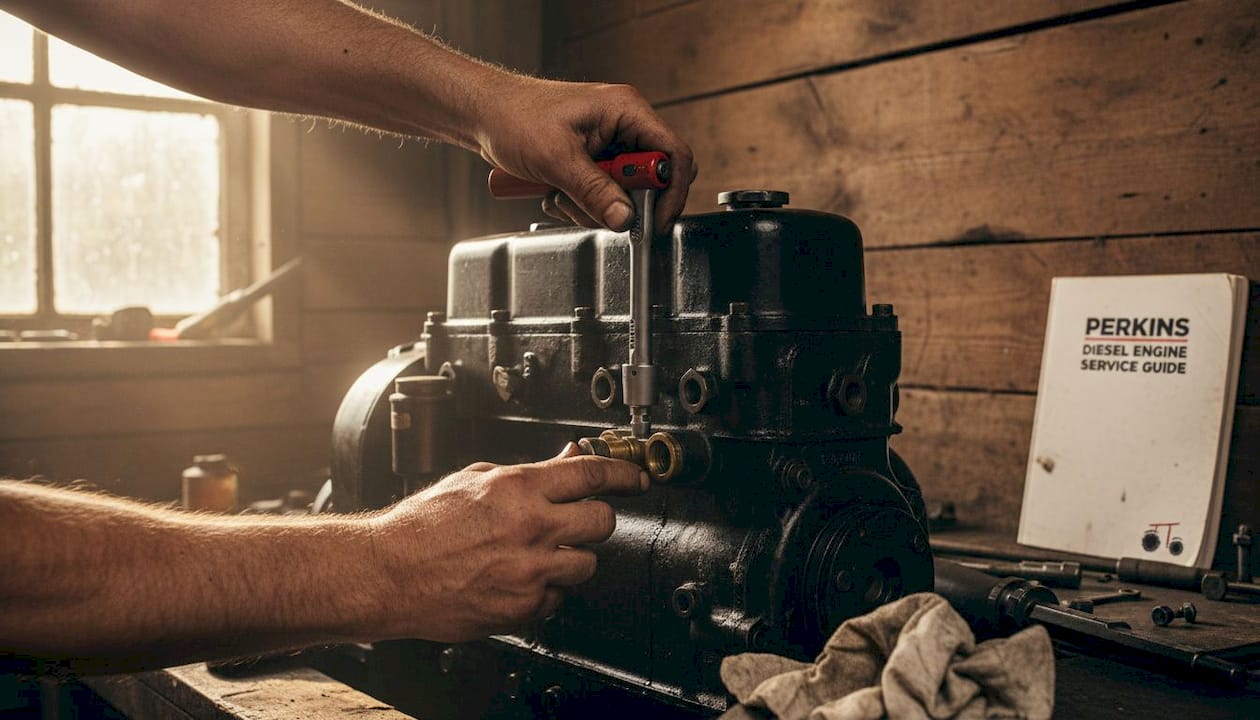
Pro Tip: Keep a calibrated torque wrench in your service kit specifically for fuel system work. The values listed in the Perkins handbook are not suggestions. They are engineered limits based on material tolerances.
Choosing the right oil viscosity
Greek temperatures vary significantly between seasons. Using the wrong viscosity grade causes cold-start wear in winter and oil film breakdown in summer.
| Season / Temperature range | Recommended viscosity |
|---|---|
| Summer (above 30°C) | SAE 15W-40 or 20W-50 |
| Spring / Autumn (10°C to 30°C) | SAE 10W-30 or 15W-40 |
| Winter (below 10°C) | SAE 5W-30 or 10W-30 |
| Extreme cold (below 0°C) | SAE 5W-30 synthetic |
Always cross-reference this table with your specific engine handbook, as some Perkins variants have narrower approved ranges.
Staying current with routine farm machinery checks is the easiest way to catch oil degradation early. Discolored oil, a milky appearance (indicating coolant contamination), or a strong fuel smell in the oil are all signs that need immediate attention.
Using quality Perkins parts list tips ensures you are also selecting the right filter grades for your oil type, which matters more than most farmers realize.
Diagnosing common Perkins engine issues
Clear maintenance protocols are vital, but knowing how to diagnose issues quickly is equally important for keeping your machinery running during peak seasons.
Perkins engines are reliable, but like any diesel motor, they have specific failure patterns. Recognizing symptoms early cuts repair costs dramatically because you catch problems before secondary damage occurs.
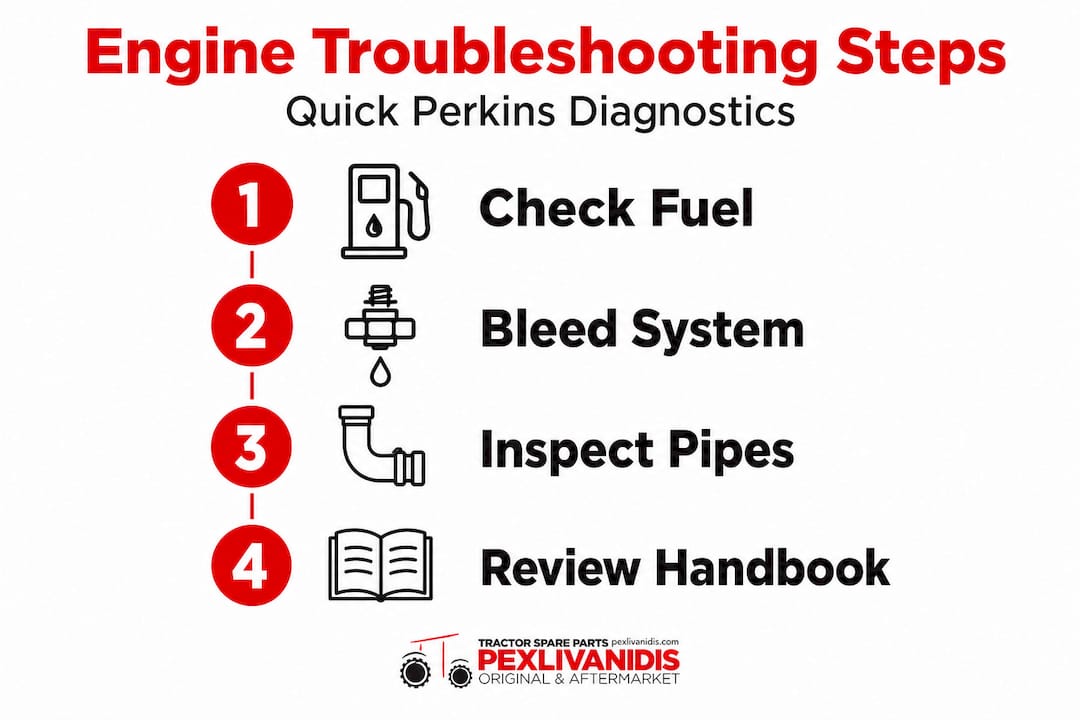
According to Perkins engine manuals, fault diagnosis references commonly cover five major symptom categories: no-start or difficult-to-start, lack of power, misfire, overheating, and lubricating oil system pressure issues.
Here is what to check for each:
- Engine will not start. Check fuel supply, bleed the system, verify that the fuel shutoff solenoid is energized, and inspect the glow plugs or cold-start aid if temperatures are low.
- Loss of power under load. Inspect the air filter first (a clogged air filter is the most common and most overlooked cause), then check injector spray patterns and timing.
- Misfire or rough running. Usually indicates a single injector fault, low compression in one cylinder, or air in the fuel line. A compression test will isolate the cylinder quickly.
- Overheating. Start with the coolant level, then the radiator cap pressure rating, then the fan belt tension. Blocked radiator cores are extremely common on dusty farm sites in Greece.
- Low oil pressure warning. Check the oil level immediately. If it is correct, suspect the pressure relief valve or a worn oil pump. Do not run the engine further until this is resolved.
| Symptom | Most probable cause | First check |
|---|---|---|
| No start | Air in fuel / solenoid fault | Bleed fuel system |
| Loss of power | Blocked air filter / injector wear | Air filter condition |
| Misfire | Injector fault / low compression | Compression test |
| Overheating | Low coolant / blocked radiator | Coolant level |
| Low oil pressure | Oil level / pump wear | Oil level and condition |
Pro Tip: Keep a small notebook in your tractor cab and write down when a symptom first appeared and under what conditions (temperature, load, hours since last service). This information cuts diagnostic time in half for both you and any mechanic you call.
Learning to troubleshoot agricultural equipment systematically rather than replacing parts at random saves significant money over a season. Similarly, following proven tractor performance tips as part of a regular schedule prevents most of these faults from developing in the first place.
When and how to source Perkins diesel motor parts
Proactive troubleshooting is only as effective as the quality of parts and sourcing. Here is how to make sure you are getting it right every time.
Sourcing the wrong part is not always obvious. Counterfeit or non-approved components often look identical to genuine Perkins parts. The difference becomes apparent only after installation, usually at the worst possible time during harvest or plowing season.
How to identify original Perkins parts
- Check the Perkins part number stamped or etched onto the component. Cross-reference it with your engine’s parts book.
- Look for packaging with Perkins branding, batch numbers, and country of manufacture information. Reputable distributors provide documentation.
- Buy from authorized dealers or established agricultural parts suppliers with a trackable supply chain. This is not the area to look for bargains from unverified sources.
- Use your engine serial number when ordering. Perkins engine variants share many visual similarities but have different specification requirements.
When to replace versus repair
- Injectors: Rebuild if the spray pattern is poor but the body is intact. Replace if the needle valve is scored or the body is cracked.
- Head gasket: Always replace. Never reuse a gasket that has been removed.
- Fuel pump: Rebuilding is possible but only with genuine internals. A poorly rebuilt pump causes more damage than the original problem.
- Belts and hoses: Replace on schedule, not when they break. A snapped timing belt costs far more than a replacement belt.
As the Perkins 4.236 Series handbook makes clear, getting fuel-system priming and torque control wrong can cause fuel-air issues or premature failures, even when parts are correct. This is the critical insight that most farmers miss. The part quality matters, but the installation procedure is equally important.
Key statistic: Industry maintenance data consistently shows that a significant percentage of diesel engine warranty claims involve correct parts installed incorrectly, with improper torque application and incomplete air bleeding being the top two procedural errors cited by engine service centers.
A detailed Perkins engine parts guide can help you cross-reference part numbers, understand substitution risks, and identify which components are safety-critical versus wear items that have more flexibility in sourcing.
The nuanced reality of Perkins motor upkeep: what most guides miss
Having covered practical steps and sourcing, let’s step back for a candid look at what farmers actually face in day-to-day engine maintenance.
Most maintenance guides treat engine upkeep as a linear checklist. Change the oil, replace the filter, bleed the fuel system, done. Real farm environments are not linear. Dust, heat, vibration, fuel quality variation, and the pressure of seasonal deadlines create conditions that push even well-maintained engines to their limits.
Here is the honest reality after years of working with farmers across northern Greece: the most damaging maintenance mistakes are not made by careless farmers. They are made by experienced, confident mechanics who trust their instincts over the handbook. A mechanic who has bled a hundred fuel systems starts to move faster. They stop checking for bubbles as carefully. They tighten fittings by feel. And that is exactly when the problems start.
The Perkins 4.236 Series handbook is explicit: getting fuel-system priming and torque control wrong causes premature failures, even when parts are correct. But reading that warning and internalizing it during a busy harvest week are two different things.
There is also a gap between handbook conditions and real field conditions. The handbook assumes clean, low-sulfur diesel. In rural Greek farming areas, fuel quality can vary. Watered-down or contaminated diesel accelerates injector wear and complicates air bleeding because dissolved gases behave differently than pure air. The handbook does not cover this scenario directly, which means experienced judgment still has a role alongside procedural discipline.
Our perspective: the handbook is the foundation, not the ceiling. Use it as your non-negotiable baseline, but also pay attention to what your engine is telling you. A change in exhaust color, a slightly different sound at idle, a fuel consumption uptick of even 5% are all signals worth investigating before they become repair bills.
If you encounter a situation that falls outside standard procedures, quick recovery troubleshooting resources can bridge the gap between handbook theory and field reality.
The farmers who get the most life out of their Perkins motors are not necessarily the most technically skilled. They are the most observant and the most consistent. Discipline beats expertise every time in engine maintenance.
Find trusted Perkins diesel motor parts and maintenance support
If you are ready to put these techniques into action, here is where to find trusted support and genuine Perkins engine parts.
At pexlivanidis.com, we stock over 20,000 agricultural machinery parts with a specific focus on serving farmers in Thessaloniki, Kavala, and the wider northern Greece region. Our inventory includes essential machinery parts across all major Perkins engine series, from filters and gaskets to injection components and belts. We offer free shipping within Greece on orders over 100€ and B2B wholesale membership for agricultural businesses. Our detailed maintenance guide for agriculture and dedicated Perkins engine parts tips resources give you the procedural support to use those parts correctly every time.
Frequently asked questions
How do I properly bleed the fuel system on a Perkins diesel motor?
Follow the air elimination steps from the Perkins 4.236 Series handbook, working from the filter housing to the injection pump and never overtightening vent screws beyond the specified torque values.
What oil viscosity should I use for my Perkins engine in Greece?
Select oil viscosity according to ambient temperature using the engine manual’s approved grades. For most of the Greek summer, SAE 15W-40 is the standard recommendation, with lighter grades appropriate for winter operation.
What are the signs of a faulty Perkins diesel motor?
Look for symptoms such as difficult starting, loss of power, misfire, overheating, or low oil pressure, all of which are outlined in Perkins engine manuals as primary diagnostic indicators.
How do I ensure I’m sourcing genuine Perkins engine parts?
Use official parts lists and your engine serial number for identification, and follow manufacturer guidance for part verification to prevent premature failures caused by incorrect or counterfeit components.