

TL;DR:
- Greek farmers face challenges distinguishing effective precision agriculture tools from costly marketing noise. Success relies on selecting technology suited to specific crops, field variability, and ensuring proper interpretation and application of data. Effective results depend on combining reliable machinery, ongoing skills development, and pilot testing to maximize farm efficiency.
The market for precision agriculture tools has exploded in recent years, and for Greek farmers, separating genuinely useful technology from expensive noise is harder than ever. Between GPS guidance systems, IoT soil sensors, drones, and variable rate applicators, it can feel like every vendor promises the same thing: better yields, lower costs, less guesswork. But the truth is that the wrong tool for your field and crop can cost you more than it saves. This guide cuts through the marketing and focuses on proven, evidence-backed precision agriculture examples that actually make sense for farms in Greece.
Table of Contents
- How to select the right precision agriculture tool
- Automated guidance and GNSS navigation systems
- Variable rate technology and in-field sensing
- IoT-based irrigation scheduling and crop monitoring
- Comparison table: Which tools fit your farm?
- Our take: Precision tools only pay off with the right skills and context
- Ready for better efficiency? Upgrade your agricultural machinery
- Frequently asked questions
Key Takeaways
| Point | Details |
|---|---|
| Start with proven tools | Automated guidance systems and GNSS navigation deliver reliable efficiency gains for Greek farmers. |
| Match technology to field | Success depends on pairing tool selection with crop, soil, and local management needs. |
| Pilot and evaluate first | Profitability and yield depend on field-scale trials before wide adoption. |
| Combine sensing with decision support | IoT sensors and digital platforms help optimize irrigation and input use, especially for Greek conditions. |
| Skill and learning matter | The value of precision tools increases with ongoing learning and integration into everyday farm decisions. |
How to select the right precision agriculture tool
Before buying any piece of technology, you need a clear framework for evaluating it. Precision agriculture is not a single product. As the FAO Digital Agriculture program defines it, precision agriculture in practice combines guidance, sensing, and analytics to manage inputs site-specifically. That means any serious investment involves at least three layers: hardware (tractors, applicators, monitors), sensing (GPS, satellite imagery, soil sensors), and decision platforms (software that turns data into actions).
The key evaluation criteria every Greek farmer should apply include:
- Crop and field suitability: Does the tool work for your specific crop type, field size, and terrain? Hilly olive groves in Crete need different solutions than flat cotton fields in Thessaly.
- Ease of use and learning curve: Technology that requires an agronomist to interpret every output is a liability if you don’t have one on-site.
- Return on investment (ROI): Will savings in inputs, fuel, or labor actually exceed the cost of the tool within a reasonable timeframe?
- Support and integration: Can the tool connect with your existing machinery, and is local service available in Greece?
A major finding from a Purdue Commercial Agriculture study is that ROI on technology bundles varies widely because learning and interpretation matter just as much as the hardware itself. Buying a soil sensor without knowing how to act on the data is like buying a thermometer without knowing what temperature means.
Pro Tip: Start with a simple, proven technology bundle such as GNSS guidance plus a basic yield monitor before adding complexity. This builds the data literacy you need to make more advanced tools pay off.
Automated guidance and GNSS navigation systems
With a framework in mind, let’s look at a foundational example: guidance systems. Automated guidance using GNSS (Global Navigation Satellite System) is arguably the most reliable entry point into precision agriculture for Greek farms. The basic value proposition is simple: your tractor drives straighter, overlaps less, and wastes fewer inputs on each pass.
The main features and considerations for Greek conditions include:
- Reduced input overlap: Better pass-to-pass accuracy means you stop double-applying fertilizer or herbicide, which adds up fast over a full season.
- Lower fuel and labor costs: Fewer passes and more consistent lines mean less time in the field.
- Works across crop types: From grain to vineyards to vegetable plots, GNSS guidance adapts to almost any field operation.
- RTK correction improves accuracy: Standard GNSS offers meter-level accuracy, but RTK (Real-Time Kinematic) correction brings it down to 2 to 3 centimeters, which is essential for row crops or narrow-row orchards.
According to Purdue research on precision ag technology, automated GNSS guidance systems consistently reduce overlap and improve consistency across field passes, making them one of the few precision agriculture tools with near-universal ROI documentation.
“The best guidance system is the one your operator uses correctly every single day. A €15,000 system sitting on auto while your team skips calibration is worse than a €3,000 system used properly.”
For Greek farms, especially medium to large operations in Thessaly, Macedonia, and Thrace, GNSS guidance combined with yield monitoring creates a feedback loop that reveals which parts of your field actually produce. That data becomes the foundation for every other precision decision you make.
Pro Tip: Combine guidance with a yield monitor or grid soil sampling from day one. The guidance saves fuel; the yield data tells you where to focus your precision investment next.
Variable rate technology and in-field sensing
Navigating efficiently is important, but what’s next for smarter input management? Enter variable rate solutions. Variable rate technology (VRT or VRA) lets you apply different amounts of fertilizer, lime, herbicide, or seed across different zones in the same field, based on either historical yield data or real-time sensor readings.
The core use cases include:
- Variable rate fertilizer application: Apply more nitrogen where your yield maps show deficiency, less where soil tests are already high.
- Variable rate seeding: Increase seed population in high-potential zones, reduce it in sandier or shallower areas.
- Lime and soil amendment management: Correct soil pH unevenly distributed across fields without blanket-treating every square meter.
The important caveat here is that VRA profitability depends heavily on field variability, information quality, and the decision support system behind it. Fields with low variability often show weak ROI from variable rate application. Fields with high variability, which is common in Greek farms that span rocky hills, river flats, and alluvial plains, can show strong returns.
| Information source | Typical use case | Profitability likelihood |
|---|---|---|
| NDVI (satellite imagery) | In-season nitrogen adjustment | Moderate, depends on crop and timing |
| Historical yield maps | Zone delineation for seeding or lime | High in variable fields |
| In-field soil sensors | Real-time EC and moisture mapping | High with proper calibration |
| Grid soil sampling | Multi-year nutrient management | Consistent but slow feedback cycle |
For nitrogen management specifically, active crop canopy sensors like the OptRx and similar tools can reduce nitrogen application without sacrificing yield, but as Frontiers research on OptRx field trials confirms, results vary by site and learning curve. A wheat farmer in Larissa with loamy soils may see 15% nitrogen reduction with no yield penalty. A dryland farmer in Evros with sandier soils may see different results entirely.
The bottom line: VRA delivers real savings, but only when paired with quality field data and a willingness to interpret the outputs correctly.
IoT-based irrigation scheduling and crop monitoring
Input management is only part of the story. Monitoring and irrigation are just as critical, and for Greek farmers dealing with increasingly hot and dry summers, irrigation efficiency is where the most urgent money is sitting.
IoT (Internet of Things) sensors connect physical field conditions, soil moisture, temperature, rainfall, and canopy stress, to digital platforms that help you decide when and how much to irrigate. The key features and success factors include:
- Real-time soil moisture monitoring: Sensors placed at multiple depths let you see exactly how much water is available to plant roots right now, not three days ago.
- Automated or alert-based irrigation triggers: Platforms can either control irrigation valves directly or send alerts to your phone when conditions hit a threshold.
- Crop stress indicators: Some systems combine meteorological data with canopy sensors to flag heat or drought stress before it becomes visible damage.
- Multi-field dashboards: For cooperative members or farmers managing multiple plots, centralized dashboards reduce the time spent driving between fields to check conditions.
The numbers from documented Greek cases are striking. The DigiAgriFood Agro Team Greece cooperative reported using IoT-based irrigation scheduling with field monitoring platforms to achieve 40% reduction in irrigation water use and 20% increase in crop yield compared to conventional management. Those are not marginal gains. For a farm paying for irrigation water or running energy-intensive pumps, a 40% reduction in water use translates directly to cash.
In Greek viticulture, digital platforms combining precision irrigation and IoT monitoring are also reducing pesticide use and labor hours. The Smyrnakis Winery case, documented by IVES open science viticulture research, shows how integrating DSS with IoT monitoring and smart traps reduced spray passes while maintaining wine quality standards. For Greek wine producers facing both labor shortages and increasing pest pressure, this kind of integration is highly relevant.
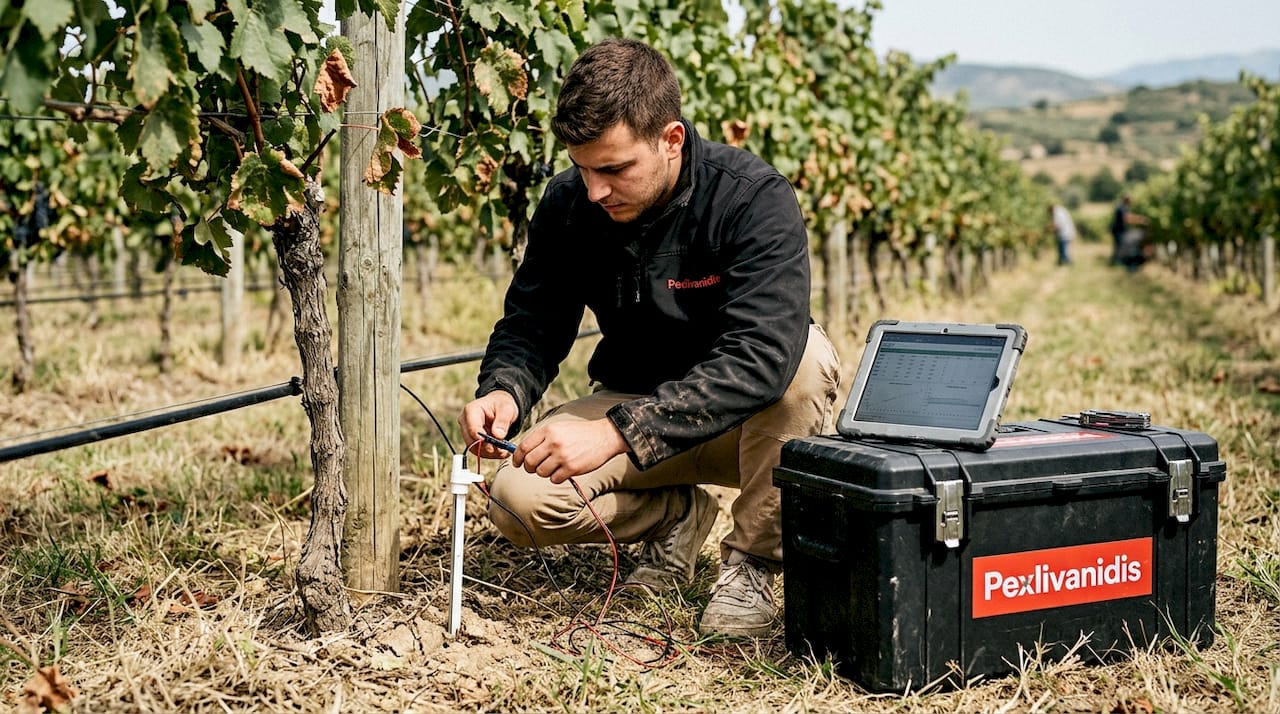
The cons to be aware of: sensor networks require maintenance, calibration, and a reliable internet connection across all monitoring points. In remote fields in Epirus or the Aegean islands, connectivity can be a limiting factor that needs solving before the technology can deliver.
Comparison table: Which tools fit your farm?
With a diverse toolkit available, let’s compare the practical fit for your specific farm needs. Not every tool deserves the same priority or budget allocation, and the right mix depends on your scale, crop, and existing machinery.
| Tool | Best fit | Typical cost range | Primary result | Caution |
|---|---|---|---|---|
| GNSS guidance (RTK) | Row crops, grain, vegetables, orchards | €3,000 to €15,000 | Fuel, input, and labor savings | Calibration and operator training required |
| Variable rate applicators | Fields with high variability | €5,000 to €25,000+ | Fertilizer and seed cost reduction | Requires quality field data to be profitable |
| IoT irrigation sensors | Irrigated crops, vineyards, horticulture | €1,500 to €10,000 | Water savings, yield improvement | Connectivity and sensor maintenance needed |
| Crop canopy sensors | Grain and cereals (nitrogen management) | €4,000 to €12,000 | Nitrogen reduction without yield loss | Results vary significantly by field |
| Yield monitors | Grain harvesting operations | €2,000 to €8,000 | Baseline data for all future decisions | Needs calibration each season |
The honest reality, supported by a Nature npj Sustainable Agriculture review, is that average efficiency gains are weak for technology bundles where farmers cannot translate information into clear management actions. Buying the table above all at once and hoping for results is not a strategy. Sequencing your investment, starting with guidance and yield monitoring, then adding sensing and VRA once you have data, is.
Our take: Precision tools only pay off with the right skills and context
Here is something the technology vendors rarely tell you: the problem on most farms is not a shortage of data. It is a shortage of the decision-making capacity to act on data correctly. We have seen Greek farmers invest in sophisticated sensor networks and VRA equipment, then default back to flat-rate applications because the outputs were too confusing or too slow to arrive when timing mattered.
The conventional advice in this space is “adopt technology and yields will follow.” That is not what field evidence says. Precision ag outcomes depend strongly on local conditions and the type of information available, which means a tool that worked on a farm in Thessaly may not work the same way on a farm in Crete or the Peloponnese.
The farms that consistently extract value from precision agriculture share three habits. First, they pilot every new tool on a clearly defined portion of their operation before full rollout. Second, they invest time, not just money, in understanding what the data means for their specific crops and soils. Third, they treat technology as a component of their farm automation workflow, not a standalone fix.
Pro Tip: Before committing to any new precision tool, run it on a 5 to 10 hectare pilot block for a full season. Compare that block’s outcomes with a nearby conventionally managed block. If you cannot see a measurable difference, the tool is not ready for your farm or you need more training before scaling up.
The hardest truth is that precision agriculture rewards farmers who are already disciplined and data-aware. If your record-keeping is inconsistent or your machinery maintenance is reactive rather than proactive, the tools will amplify those problems rather than solve them.
Ready for better efficiency? Upgrade your agricultural machinery
Precision agriculture tools only perform at their potential when the machinery underneath them is reliable and well-maintained. A guidance system on a tractor with a worn steering linkage will never hit its accuracy targets. An IoT irrigation sensor paired with a pump running on a failing motor will give you accurate data about a system that is failing anyway.
At Pexlivanidis, we support Greek farmers and agricultural businesses through the transition to more efficient, technology-supported farming. Our agricultural machinery parts guide covers the components most critical to precision-ready equipment, and our machinery maintenance tips help you build the preventive maintenance habits that keep sensors and guidance systems working as intended. When you are ready to take the next step, our machinery upgrade tips connect you to practical options across our inventory of over 20,000 parts, with free shipping on orders over 100€ across Greece.
Frequently asked questions
Which precision agriculture tool delivers the most consistent ROI for Greek farms?
Automated guidance systems and GNSS navigation deliver proven efficiency gains for Greek farms, with well-documented benefits in reducing overlap, fuel use, and input costs across most crop types.
Are variable rate technologies profitable in all Greek field conditions?
No. Profitability varies by field variability and information source, so pilot trials on your specific land are essential before committing to a full VRA investment.
Can IoT irrigation platforms improve yields and reduce water use in Greek agriculture?
Yes. Documented Greek cases show up to 40% reduction in irrigation water use and a 20% yield increase using sensor-based scheduling platforms compared to conventional irrigation management.
How can farmers avoid common mistakes when adopting precision agriculture tools?
Focus on pilot trials before full rollout, build your data literacy alongside the hardware investment, and choose tools matched to your specific crops and field conditions rather than buying the most advanced option available.
Do all precision ag tech bundles improve farm efficiency?
No. Most bundles only deliver gains when farmers can translate data into management actions, and evidence shows average efficiency gains are weak for bundles adopted without proper skills, training, and workflow integration.