

TL;DR:
- Regular farm machinery maintenance significantly reduces downtime, operating costs, and safety risks, leading to higher productivity and asset value. Predictive maintenance using sensor data offers long-term cost savings and enhanced reliability, especially for larger farms, while small farms can benefit from structured preventive routines. Systematic maintenance planning and proper parts inventory are essential for building resilience and ensuring seasonal farm success.
Every hour a tractor sits broken in the field during harvest season is money walking out the door. For farm operators and maintenance managers across Greece, machinery downtime is not just an inconvenience — it is a direct threat to profitability, seasonal deadlines, and the long-term health of the operation. Smart, consistent maintenance is the single most controllable factor separating farms that grow year after year from those that spend their margins on emergency repairs. This guide breaks down the seven most valuable benefits of farm machinery maintenance and gives you a clear, practical roadmap to capture every one of them.
Table of Contents
- Why maintenance matters: Criteria for success
- 7 essential benefits of farm machinery maintenance
- Predictive vs. traditional maintenance: What works best?
- Optimizing your farm’s maintenance plan: Steps to success
- Perspective: Why most farms miss out on the biggest gains
- Boost your farm’s results with the right parts and support
- Frequently asked questions
Key Takeaways
| Point | Details |
|---|---|
| Higher uptime | Well-maintained equipment spends less time in the shop and more time working in your fields. |
| Lower costs | Routine care and predictive maintenance can cut repair bills and overall operating expenses by double digits. |
| Fewer breakdowns | Effective maintenance means fewer unexpected failures and a more predictable workflow. |
| Longer machine life | Following a proper maintenance routine extends your equipment’s working years and improves resale value. |
Why maintenance matters: Criteria for success
Before we talk solutions, we need to agree on what “good maintenance” actually looks like in practice. A lot of operators think of maintenance as an expense. The better framing is this: maintenance is an investment that controls risk. The real question is whether your current approach is generating a positive return.
The cost of machinery downtime is enormous at every scale. A single day of unplanned harvester downtime during peak season can cost a Greek farm thousands of euros in lost output, rushed parts orders, and contract penalties. Smaller farms suffer even more proportionally because they cannot spread the loss across a larger operation. Understanding the full machinery lifecycle of each piece of equipment helps you make smarter decisions about when to repair, replace, or upgrade.
Machinery repair costs on large corn farms average $39 per acre in 2024, up from $32 per acre in 2021, with total crop machinery costs averaging $178 per acre. Economies of scale help larger farms, but the upward trend in repair costs affects everyone.
Here are the five core criteria every farm in Greece should use to evaluate their maintenance approach:
- Uptime: What percentage of operating hours is each machine actually available and working?
- Operating costs: What is your total cost per acre or per hour of use, including fuel, parts, and labor?
- Repair predictability: Are you reacting to breakdowns or scheduling repairs proactively?
- Safety: Is your equipment in a condition that protects your workers and meets local regulations?
- Scalability: Can your maintenance plan grow with your operation without becoming unmanageable?
If you cannot answer these five questions confidently, your maintenance program has gaps. The good news is that closing those gaps delivers compounding returns.
7 essential benefits of farm machinery maintenance
With the evaluation criteria set, let’s get into the top practical benefits farms in Greece stand to gain from a strong maintenance strategy.
1. Higher machine uptime and reliability
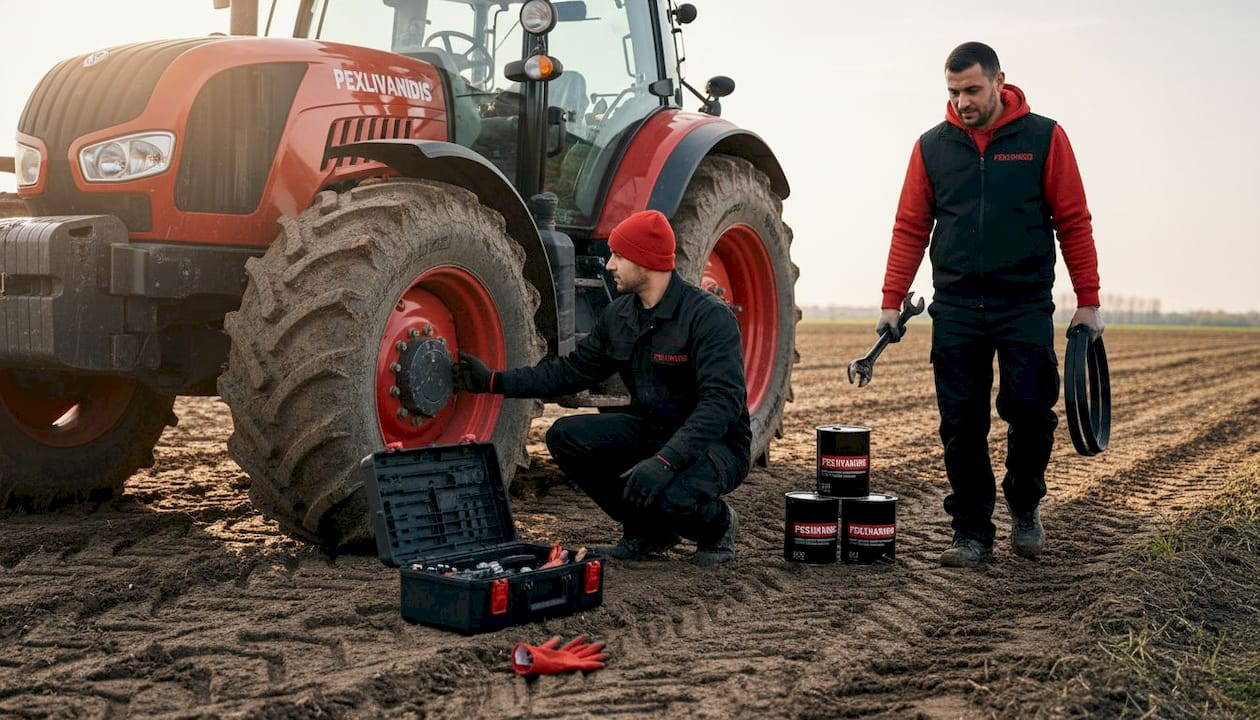
Uptime is everything during planting and harvest windows, which are often narrow in Greek growing conditions. John Deere’s predictive maintenance program demonstrates a 20 to 25 percent improvement in machine uptime, a 15 to 30 percent reduction in operating costs, and a 50 to 70 percent drop in unplanned downtime. Those numbers are not theoretical. They reflect what happens when farms stop guessing and start using data to manage equipment health.
2. Lower long-term operating and repair costs
Every ignored oil change, worn belt, or dirty air filter is a future repair bill multiplying in the background. Routine maintenance costs a fraction of what emergency breakdowns cost, both in parts and in the labor required to diagnose and fix urgent failures under pressure. Farms that reduce machinery downtime through structured service programs consistently report lower total annual repair bills compared to reactive operations.
3. Fewer unplanned breakdowns and interruptions
Unplanned breakdowns do not just cost you the repair. They interrupt workflow, delay neighboring tasks, create supply chain problems, and demoralize your crew. A broken irrigation pump in July or a seized gearbox during olive harvest does not just pause one machine — it can cascade across your entire operation. Regular inspections catch developing problems before they become field failures.
4. Extended machinery lifespan and asset value
A well-maintained tractor can work reliably for 15,000 hours or more. A neglected one might give you half that before requiring a major rebuild or replacement. When you protect the mechanical integrity of your equipment, you are protecting a capital asset worth tens of thousands of euros. You also preserve strong resale value if you choose to upgrade. Following a solid machinery maintenance guide adds years to your equipment’s useful life.
5. Increased farm productivity and output
When machines work reliably, your whole operation runs at its intended pace. You plant on time, irrigate on schedule, and harvest at peak quality. The difference between a farm that hits its seasonal windows and one that misses them by a week due to equipment trouble can be dramatic in terms of yield quality and market prices. Machinery that performs consistently gives you control over your calendar.
6. Enhanced worker safety and regulatory compliance
Worn brakes, faulty hydraulic lines, and broken safety guards are not just maintenance failures — they are liability risks. Worker injuries cost farms in both human terms and financial penalties. Regular maintenance keeps safety systems functional and ensures your equipment meets Greek and EU agricultural safety standards. A documented maintenance schedule also protects you in the event of an inspection or insurance claim.
7. Better planning and budgeting with predictable maintenance
When you schedule maintenance instead of reacting to failures, your cash flow becomes far more predictable. You can budget for parts and service visits in advance, negotiate better prices with suppliers, and avoid the premium cost of emergency sourcing. This single benefit transforms maintenance from an unpredictable expense into a manageable line item.
Pro Tip: Start predictive maintenance by fitting at least one critical machine — your primary tractor or combine — with a low-cost telematics device. Track engine hours, fuel consumption, and fault codes. Within one season, you will have enough data to start catching problems before they become breakdowns.
“Farms adopting structured maintenance programs report up to 30% reduction in operating costs alongside a 70% drop in unplanned downtime, fundamentally changing how they manage seasonal risk.”
Predictive vs. traditional maintenance: What works best?
Now that you know the core benefits, it is time to compare the two main strategies to help you decide the right fit for your operation.
Traditional preventive maintenance involves scheduled service tasks performed at regular intervals, regardless of whether the machine shows symptoms. This includes daily visual checks, a 50-hour initial service on new equipment, oil and filter changes every 100 to 500 hours depending on the machine, regular lubrication, and seasonal cleaning. According to John Deere’s maintenance data, these baseline tasks form the foundation of any reliable maintenance program.
Predictive maintenance uses real-time sensor data, telematics, and diagnostics to monitor machine health continuously and only trigger service when data indicates a developing problem. This approach avoids unnecessary repairs while catching critical failures early.
| Feature | Traditional preventive | Predictive maintenance |
|---|---|---|
| Cost to implement | Low to moderate | Moderate to high upfront |
| Ongoing cost | Scheduled parts and labor | Lower long-term repair costs |
| Downtime risk | Medium (interval-based) | Low (data-driven) |
| Best for farm size | Small to medium | Medium to large |
| Data requirements | Minimal | Sensor and software integration |
| Repair predictability | Moderate | High |
| Suitable machinery age | All ages | Newer, connected equipment |
Research from the European Environment Agency confirms that while large farms benefit more from economies of scale with predictive technology, even smaller operations improve resilience through planned investment in specialized maintenance equipment and tools. The key insight is that reactive maintenance — fixing things only when they break — is the most expensive approach long term, regardless of farm size.
Here is a practical guide to choosing the right approach:
- Small farms (under 50 hectares): Stick to structured preventive maintenance with detailed service logs. Focus on oil changes, filter replacements, and seasonal inspections. Use simple checklists.
- Medium farms (50 to 200 hectares): Begin layering in basic telematics on key machines. A preventive maintenance strategy combined with data logging gives you the best return.
- Large farms (200+ hectares): Full predictive maintenance integration pays off quickly. The upfront investment in connectivity and diagnostics is recovered within two to three seasons.
Pro Tip: Regardless of your farm size, start preventative tractor maintenance with a daily five-minute walk-around check. Catching a hydraulic leak or a low coolant level before you start the engine costs nothing and can prevent a catastrophic failure mid-field.
Optimizing your farm’s maintenance plan: Steps to success
After understanding the theory, here is how to put the right maintenance plan into action on your own land.
Step 1: Assess your machinery inventory and condition
List every piece of equipment you operate, its age, current hours, and last service date. Identify which machines are highest risk based on age, criticality, and past repair history. Large-scale agricultural investment in resilient equipment starts with knowing exactly what you have and what it needs.
Step 2: Build a master maintenance schedule
Assign service intervals to each machine based on manufacturer specifications and your actual usage patterns. Tie tasks to both calendar dates and hour-meter readings, whichever comes first.
Step 3: Track all maintenance activity in a log
Paper logs are better than nothing, but digital logs are far better. A simple spreadsheet or a dedicated farm management app lets you sort by machine, identify patterns, and share information with your mechanic or supplier. Follow the tractor maintenance workflow used by experienced Greek operators to build this habit quickly.
Step 4: Review and adjust quarterly
Your maintenance plan is a living document. Every quarter, review which tasks were completed on time, which were delayed, and whether any unplanned repairs occurred. Adjust intervals and priorities accordingly.
Step 5: Stock critical spare parts on-site
Waiting two days for a filter or a belt during harvest is unacceptable. Identify the five to ten most commonly replaced parts for each major machine and keep them in stock.
| Season | Key tasks | Machines to prioritize |
|---|---|---|
| Spring (pre-planting) | Full service, oil change, tire check | Tractors, seeders, sprayers |
| Summer (active season) | Daily checks, cooling system flush, filter changes | Irrigation equipment, harvesters |
| Autumn (harvest) | Combine service, grain cart inspection, brake check | Harvesters, transport vehicles |
| Winter (off-season) | Deep clean, corrosion protection, parts replacement | All equipment |
Pro Tip: Use a free cloud-based spreadsheet shared with your mechanic so service records are always accessible and up to date, even when you are in the field and your mechanic is at the workshop.
Perspective: Why most farms miss out on the biggest gains
Here is an uncomfortable truth: most farms in Greece leave significant money on the table not because they ignore maintenance entirely, but because they stop just short of doing it systematically. They do oil changes, sure. They fix things when they break. But they never build the documentation, data habits, or forward-looking schedule that transforms maintenance from a chore into a competitive advantage.
Conventional advice in this space still over-emphasizes the break-fix mindset. “Keep it running” is the goal, not “understand why it breaks.” That is short-sighted. The farms that compete strongest over a 10-year horizon are not the ones with the newest machines — they are the ones that know their equipment’s history deeply enough to predict its future.
Real machinery lifecycle stories from experienced operators show that machinery kept on systematic maintenance schedules routinely outlasts comparable equipment by four to six years. That is four to six years of avoided capital expenditure.
The overlooked gains from proactive maintenance include:
- Stress reduction for farm owners and operators who stop dreading the next surprise breakdown
- Proactive budgeting that smooths seasonal cash flow and avoids emergency borrowing
- Improved resale value that makes upgrading financially viable rather than painful
“Seasonal repairs may keep you running, but only smart planning creates true resilience.”
Small farms often assume predictive maintenance technology is out of their reach. It is not. Even basic digital tracking and a structured service calendar deliver a measurable share of the gains that large operations achieve with full telematics integration. The gap between doing nothing and doing something simple is far larger than the gap between simple and sophisticated.
Boost your farm’s results with the right parts and support
Ready to take the next step? Greek farm operators who want to translate these maintenance principles into real results need two things: the right knowledge and the right parts. Pexlivanidis.com offers both. Explore the full guide to essential agricultural machinery parts to understand exactly what your equipment needs at each service interval. For practical techniques on keeping machines running at their best, the guide to peak machinery performance gives you step-by-step methods used by experienced operators across northern Greece. You will also find detailed maintenance tips covering every major equipment category, with over 20,000 parts in stock and free shipping across Greece for orders above 100 euros.
Frequently asked questions
How much can predictive maintenance save Greek farms each year?
Predictive maintenance can reduce annual operating costs by 15 to 30 percent and cut unplanned downtime by up to 70 percent, according to John Deere program data. Even partial adoption delivers measurable savings within the first season.
What is the average annual maintenance cost for farm machinery?
On large farms, total machinery costs average $178 per acre, with annual repair costs rising from $32 to $39 per acre between 2021 and 2024. Greek farms should benchmark their own per-acre costs against these figures to identify improvement opportunities.
Which maintenance style is best for small vs. large farms?
A mix of preventive and predictive maintenance works best for most operations. Large farms gain more from predictive technology due to scale benefits, while smaller farms achieve strong results through consistent scheduled checks and well-maintained service logs.
How often should farm machinery be serviced?
Daily visual inspections, a 50-hour initial service, and oil and filter changes every 100 to 500 hours are the standard intervals for most equipment types, adjusted for usage intensity and operating conditions.