

TL;DR:
- Proper equipment installation reduces downtime by 40% during peak harvest seasons.
- Thorough pre-planning, documentation, and adherence to safety standards are essential for success.
- Correct installation enhances productivity, extends equipment lifespan, and ensures regulatory compliance.
Poor equipment installation is one of the most expensive mistakes a Greek farmer can make. A misaligned loader, a leaking hydraulic line, or a GPS system that was never properly calibrated can idle a tractor for days during peak harvest season. Seasonal preparation reduces downtime 40%, which means every hour you invest in doing the job right pays back many times over. This guide walks you through a proven installation workflow built for the realities of Greek farms, covering preparation, execution, compliance, and long-term productivity gains.
Table of Contents
- Preparation and planning: What to do before you start
- Step-by-step installation workflow for agricultural equipment
- Troubleshooting, compliance, and common mistakes
- Maximizing results: Benchmarking productivity and long-term gains
- Beyond the manual: What most guides leave out about equipment installation
- Get the most from your equipment: Expert help and next steps
- Frequently asked questions
Key Takeaways
| Point | Details |
|---|---|
| Plan before you start | Thorough preparation, from gathering tools to reviewing legal requirements, saves time and prevents costly mistakes. |
| Follow every step | A proven workflow—mounting, connecting, and testing—ensures your equipment works safely and efficiently. |
| Prioritize safety and compliance | Adhering to Greek and EU regulations is vital for safety, insurance, and avoiding penalties. |
| Maintenance secures your gains | Seasonal checks and correct installation dramatically reduce future downtime and boost productivity. |
Preparation and planning: What to do before you start
Once you understand the risks of skipping steps, start by getting everything in order before turning a wrench. Rushing into an installation without a clear plan is how farmers end up with equipment that fits poorly, violates safety codes, or fails within the first season. A few hours of preparation can save you days of rework.
Site access and compatibility checks are the foundation. Walk the installation area and confirm there is enough clearance for the equipment and any lifting tools you will need. Heavy components may require lift assist or multiple people, and you need to verify tractor compatibility before anything else. Check your tractor’s hydraulic flow rate, PTO output, and frame mounting points against the equipment manufacturer’s specifications.
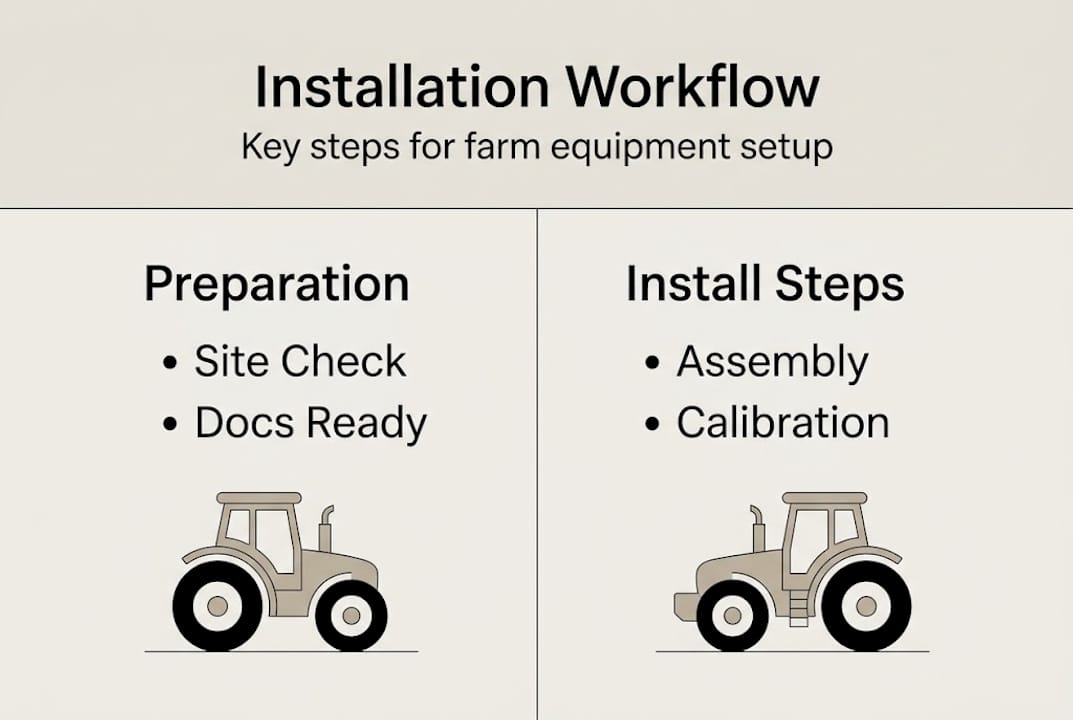
Next, gather your documentation. Greek and EU regulations require specific paperwork for certain equipment categories. Review the EU Machinery Regulation modules that apply to your machinery type before you begin. Keep all certificates, CE declarations, and operator manuals on site during installation.
Using choosing OEM spare parts from a reliable local supplier is not just about quality. It also ensures your components meet the exact tolerances specified in the equipment manual, which matters for both performance and warranty coverage.
Required tools and materials checklist:
- Torque wrench (calibrated to manufacturer specs)
- Hydraulic line fittings and Teflon tape
- Mounting hardware (bolts, washers, lock nuts)
- Lift jack or hydraulic floor jack
- Multimeter for electrical connections
- Safety gloves, goggles, and steel-toed boots
- Camera or smartphone for documentation
| Tool/Material | Purpose | Notes |
|---|---|---|
| Torque wrench | Tighten bolts to spec | Prevents over/under-tightening |
| Teflon tape | Seal threaded hydraulic fittings | Use on all NPT threads |
| Mounting hardware | Secure equipment to tractor | Match grade to load rating |
| Multimeter | Test electrical connections | Check voltage and continuity |
| Lift jack | Position heavy components | Required for loaders and cabs |
Pro Tip: Photograph every stage of the installation from multiple angles. These images are invaluable if you ever need to prove compliance during an inspection or file an insurance claim.
Step-by-step installation workflow for agricultural equipment
With everything prepped, you’re ready to follow the workflow for safe, efficient installation. Skipping steps in sequence is the single most common cause of installation failures, so treat each phase as non-negotiable.
The general workflow for agricultural equipment installation follows a consistent structure: preparation, mounting, attaching components, hydraulic and electrical connections, system bleeding, tool attachment, and final inspection. Proper torque and alignment is crucial to both safety and equipment longevity.
Installation steps:
- Prepare the tractor. Park on level ground, engage the parking brake, and disconnect the battery before any electrical work.
- Mount the main frame or bracket. Align mounting points carefully and hand-tighten all bolts before applying final torque.
- Attach major components. Lift heavy parts into position using a jack or with a second person assisting.
- Connect hydraulic lines. Route hoses without sharp bends, secure with clamps, and apply Teflon tape to all threaded fittings.
- Make electrical connections. Match wire colors, use weatherproof connectors, and test continuity with a multimeter.
- Bleed the hydraulic system. Cycle the system slowly to purge air pockets before applying full load.
- Attach implements or tools. Connect the PTO shaft, three-point linkage, or quick-attach plate as applicable.
- Perform final inspection. Check all torque values, look for leaks, and test all functions at low speed before field use.
| Equipment type | Key installation focus | Calibration requirement |
|---|---|---|
| Front loader | Frame alignment and hydraulic flow | Test lift capacity at full extension |
| GPS guidance system | Antenna placement and receiver setup | 10 to 15 minutes for 2.5 cm accuracy |
| Cab or ROPS | Bolt torque and structural integrity | Visual inspection after first 10 hours |
For assembling tractor attachments, always refer to the specific attachment manual rather than relying on general knowledge. Each implement has unique torque values and alignment tolerances.
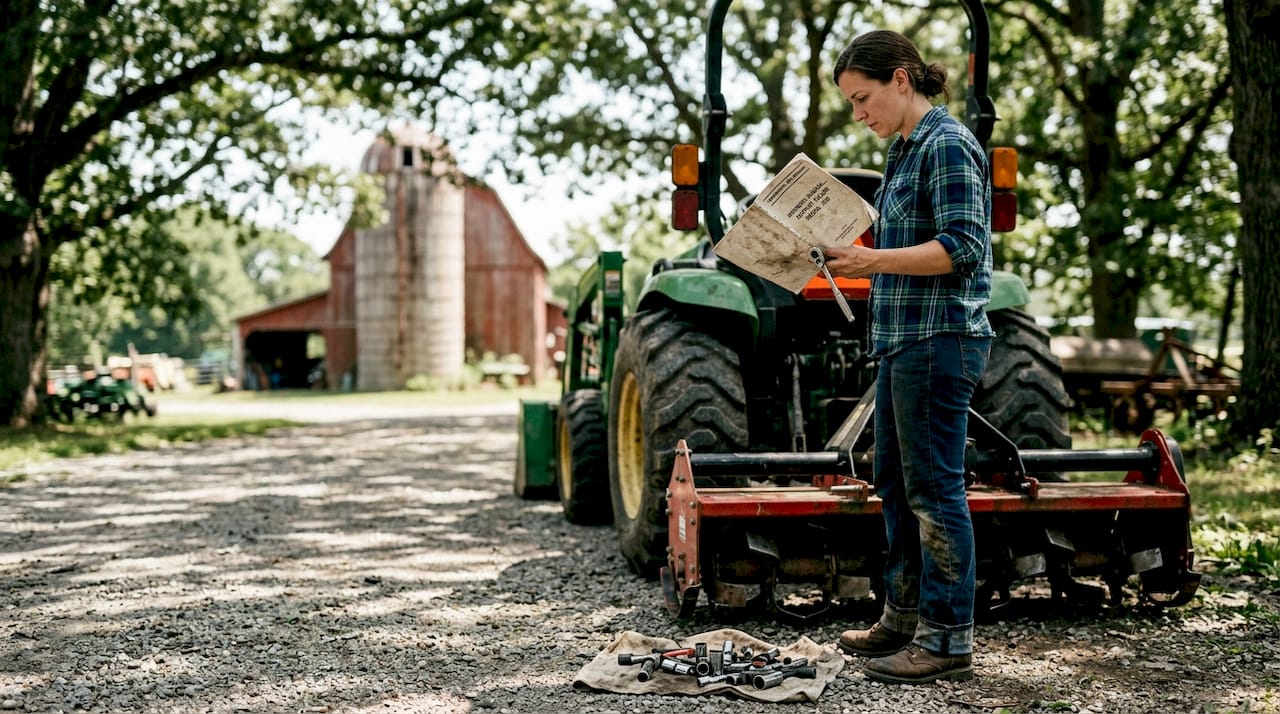
Pro Tip: Never bend hydraulic hoses at angles tighter than the manufacturer’s minimum bend radius. A kinked hose restricts flow, builds heat, and fails prematurely. Route hoses along the frame with gentle curves and secure them every 30 cm.
For a deeper look at fastener specs and connection types, the tractor spare parts installation guide covers the most common scenarios on Greek farms.
Safety note: If a component weighs more than 25 kg or requires positioning above head height, always use a mechanical lift or get a second person involved. Never work under unsupported heavy equipment.
Troubleshooting, compliance, and common mistakes
Even with the best step-by-step plan, challenges arise. Here’s how to tackle them efficiently and stay on the right side of Greek and EU regulations.
Common installation mistakes to avoid:
- Misaligning mounting brackets before final torque
- Under-tightening hydraulic fittings, which causes slow leaks under pressure
- Over-tightening bolts, which strips threads and weakens connections
- Skipping the system bleed after hydraulic connections
- Failing to test electrical circuits before reconnecting the battery
- Not reviewing the compliance documentation for the specific equipment type
Conformity with EU Machinery Regulation and CEN/TC 144 is required for legal operation of most agricultural machinery in Greece. This is not optional paperwork. It affects your insurance coverage and your ability to operate legally on public roads and shared land.
For pesticide application equipment specifically, inspection certification is mandatory in Greece. Sprayers must be registered in the ΠΥΑΑΜ (Μητρώο Μηχανημάτων Εφαρμογής Γεωργικών Φαρμάκων) system and pass periodic inspections. Operating without this certification can result in fines and loss of subsidy eligibility.
You can review the full CEN/TC 144 safety standards that apply to agricultural machinery in Europe. These standards cover everything from guards and shields to noise limits and vibration thresholds.
“Skipping regulatory steps may void your insurance and risk fines that far exceed the cost of proper compliance.”
When troubleshooting leaks, start at the highest-pressure point in the circuit and work outward. A leak that appears at a hose fitting is often caused by a loose connection two joints upstream. For unusual noises after installation, check for loose bolts, misaligned shafts, or air in the hydraulic system before assuming a component is faulty.
Using benefits of genuine parts matters most when troubleshooting. Aftermarket components with slightly different tolerances can introduce problems that are very hard to diagnose without knowing the part’s exact specifications.
Know when to call a professional. If you are dealing with a pressurized hydraulic system failure, a structural crack in a mounting frame, or any electrical fault near fuel lines, stop and get a qualified technician involved.
Maximizing results: Benchmarking productivity and long-term gains
After installation and troubleshooting, here’s how efficient workflows translate into real, ongoing benefits for your farm operation.
Proper installation boosts productivity and reduces leaks and downtime significantly. A GPS system added to an existing tractor brings precision farming capability without purchasing new equipment. A correctly installed front loader increases multi-task efficiency by allowing one operator to handle material movement and field work in the same session.
Key performance benefits of correct installation:
- Reduced unplanned downtime during critical planting and harvest windows
- Lower hydraulic fluid consumption from eliminated leaks
- Improved operator safety and reduced fatigue
- Longer equipment lifespan through proper alignment and torque
- Better fuel efficiency from correctly calibrated implements
| Metric | Before structured workflow | After structured workflow |
|---|---|---|
| Unplanned downtime per season | 4 to 6 days | 1 to 2 days |
| Hydraulic leak incidents | 3 to 5 per year | 0 to 1 per year |
| GPS pass accuracy | Manual, variable | Within 2.5 cm consistently |
| Equipment lifespan | 8 to 10 years | 12 to 15 years |
Seasonal maintenance can cut downtime by 40%, and the gains compound when combined with correct initial installation. Greek farmers who follow a documented workflow report fewer emergency repairs and more predictable operating costs across the season.
Ongoing maintenance locks in those gains. After the first 10 operating hours, re-torque all bolts, inspect hydraulic lines under load, and check electrical connections for corrosion. Set a calendar reminder for the 50-hour and 200-hour service intervals. Explore equipment upgrades for efficiency once your baseline installation is solid and you are ready to expand capability.
Beyond the manual: What most guides leave out about equipment installation
Most installation guides focus on the physical steps and stop there. What they rarely address is the value of documentation, team communication, and the real cost of the DIY-versus-dealer decision.
Photo documentation is not just for compliance. When a component fails two seasons later, those installation photos tell you exactly how it was mounted, which hose went where, and whether the original setup matched the manual. That saves hours of diagnostic time and prevents arguments with suppliers or insurers.
Team communication is equally underrated. If two workers install a piece of equipment without a shared checklist, one person’s “good enough” is another person’s missed torque spec. A five-minute briefing before installation and a signed-off checklist at the end costs nothing and prevents the kind of errors that show up at the worst possible moment.
The DIY-versus-dealer question is not black and white. For routine attachments on familiar equipment, an experienced operator can handle installation confidently. For complex hydraulic systems, GPS integration, or anything that affects the tractor’s structural integrity, dealer involvement is worth the cost. The smartest approach combines both: use a dealer for initial setup and certification, then handle routine maintenance and minor installations yourself. Investing in long-term efficiency upgrades becomes much easier when your baseline installation is documented and compliant from day one.
Get the most from your equipment: Expert help and next steps
To implement what you’ve learned and go even further, tap into the expert resources available at Pexlivanidis. With over 20,000 agricultural machinery parts in stock and free shipping within Greece on orders over 100€, getting the right components for your installation has never been more straightforward. Browse the full breakdown of types of machinery parts to identify exactly what your tractor or implement needs. Once your equipment is installed, the guide on maintaining machinery will help you protect that investment through every season. Whether you are outfitting a single tractor or managing a larger fleet, Pexlivanidis offers the parts, knowledge, and support to keep your operation running at full capacity.
Frequently asked questions
What are the first steps to check before installing new agricultural equipment?
Site access and compatibility checks are essential before you begin. Verify tractor compatibility, gather all required tools, and review safety regulations specific to Greek farms.
How can I avoid leaks in hydraulic connections during installation?
Use a torque wrench to tighten fittings to specification and apply Teflon tape on threaded connections. Torque specs and Teflon tape are the two most reliable defenses against hydraulic leaks.
What are the compliance requirements for agricultural equipment in Greece?
Compliance with EU and Greek standards is mandatory for legal operation. Conformity with EU Machinery Regulation and CEN/TC 144 is required, and pesticide sprayers must be certified via the ΠΥΑΑΜ registry.
How does correct installation improve productivity?
Correct installation boosts uptime and reduces leaks and breakdowns significantly. Proper installation cuts downtime and increases efficiency by eliminating hydraulic failures and manual errors.
Should I install equipment myself or use a dealer?
DIY can save cost, but dealer installation ensures warranty coverage and compliance assurance. Combining both approaches tends to yield the best results for most Greek farm operations.