

A tractor breaking down mid-harvest is not just frustrating. It can cost you an entire day’s work, delay planting schedules, and pile up repair bills that eat into your margins. Greek farmers and equipment operators know this reality better than anyone. The good news is that having the right repair tools on hand changes everything. A well-stocked toolkit means you can handle most field emergencies yourself, without waiting hours for a technician to arrive. This guide walks you through the essential tools every Greek farmer needs, how to choose them wisely, and how to organize them for fast, reliable repairs.
Table of Contents
- How to choose the right repair tools
- Top must-have hand tools for farm repairs
- Crucial power and specialty tools
- Essential safety gear and field support tools
- Quick-reference comparison: Must-have repair tools
- Situational tips: How to adjust your toolkit for different machinery
- Get the right tools and parts for your farm
- Frequently asked questions
Key Takeaways
| Point | Details |
|---|---|
| Choose tools by repair needs | Select tools that match your most frequent breakdowns and machinery models. |
| Prioritize quality and durability | Investing in rugged, reliable tools saves money and reduces downtime in the long run. |
| Don’t skip safety gear | Essential protective equipment prevents injuries and ensures you can keep working safely. |
| Power tools boost efficiency | Adding cordless impact wrenches and diagnostic tools enables faster, more complex repairs. |
| Customize for your operation | Adapt your toolkit for each machine and task, and keep it organized for field repairs. |
How to choose the right repair tools
Not every tool belongs in every toolkit. The first step is thinking about the repairs you actually do most often. Do you spend more time replacing belts and filters, or are you frequently dealing with hydraulic lines and electrical faults? Your answer shapes your priorities.
Here are the key factors to consider when building your toolkit:
- Match tools to your most common repairs. If you run a John Deere tractor and a sprayer, your wrench sizes and fittings will differ from someone running older Soviet-era equipment.
- Check brand and model compatibility. Some tractors use metric fasteners exclusively, while others mix metric and imperial. Know your machines before you buy.
- Prioritize versatility. Tools that work across multiple machines give you more value per euro spent.
- Choose durability over price. Field conditions in Greece, from summer heat to muddy winter soil, are tough on tools. Cheap tools fail when you need them most.
- Think about storage and transport. A tool you cannot find in a hurry is useless. Routine checks for farm machinery confirm that a proper toolkit improves uptime and limits costly downtime.
Pro Tip: Use foam trays or color-coded handles to organize your tools. When you reach into a toolbox under pressure, you want your hand to land on the right tool immediately. A good machinery care guide will also help you identify which tools align with your specific maintenance schedule.
Top must-have hand tools for farm repairs
Hand tools are the foundation of any repair kit. They handle the majority of everyday fixes and cost far less than power tools. Wrenches, screwdrivers, and pliers are the backbone of any agricultural toolkit, and skipping them is not an option.
Here is what every Greek farmer should have:
- Combination wrench set (metric and imperial). Bolts and nuts on tractors and implements come in both standards. A full set from 8mm to 32mm covers most situations.
- Flathead and Phillips screwdrivers in multiple sizes. Electrical panels, covers, and adjustment screws all need these. Do not rely on a single size.
- Adjustable pliers and locking pliers. Locking pliers (also called Vise-Grips) hold parts in place while you work with your other hand. Invaluable for solo repairs.
- Ball-peen hammer and a small sledge hammer. Stubborn bearings, seized pins, and stuck parts respond to the right hammer. A rubber mallet is also worth adding for softer surfaces.
- Torque wrench. Over-tightening bolts on engine heads or wheel hubs causes serious damage. A torque wrench prevents that.
Pro Tip: Invest in tools with insulated handles, especially if you work near electrical systems or in wet conditions. It is a small cost that protects you from a serious hazard. Pair your hand tools with solid agricultural maintenance tips and a clear preventative maintenance for tractors routine to get the most out of every repair session.
Crucial power and specialty tools
Some repairs simply cannot be done efficiently with hand tools alone. Power tools save time, reduce physical strain, and let you tackle jobs that would otherwise require a workshop visit. Cordless impact wrenches and diagnostic readers allow farmers to handle complex repairs independently, right in the field.
The power and specialty tools worth investing in:
- Cordless impact wrench. Removes rusted or over-torqued bolts in seconds. Choose an 18V or 20V model with at least 400 Nm of torque for tractor work.
- Angle grinder. Cuts through seized bolts, trims metal parts, and cleans rust off surfaces. A 115mm or 125mm disc size works well for most farm tasks.
- Portable drill with a full bit set. Drilling new holes, driving screws, and mixing fluids all become faster with a good cordless drill.
- Hydraulic floor jack rated for your tractor’s weight. Never work under a tractor supported only by a standard car jack. Get a jack rated for at least 5 tons.
- OBD diagnostic scanner. Modern tractors have electronic control units. A scanner reads fault codes and saves you from guessing what is wrong.
- Grease gun and pressure washer. Greasing fittings regularly prevents wear. A pressure washer cleans components before inspection so you can actually see what you are dealing with.
Pro Tip: Always check the voltage and charger compatibility of your cordless tools before buying. Rural areas in Greece sometimes have voltage fluctuations, and using the wrong charger can damage batteries quickly. For a broader view of how these tools fit into your overall strategy, the maintenance tips for tractors and maintain agricultural machinery guides are worth reading.
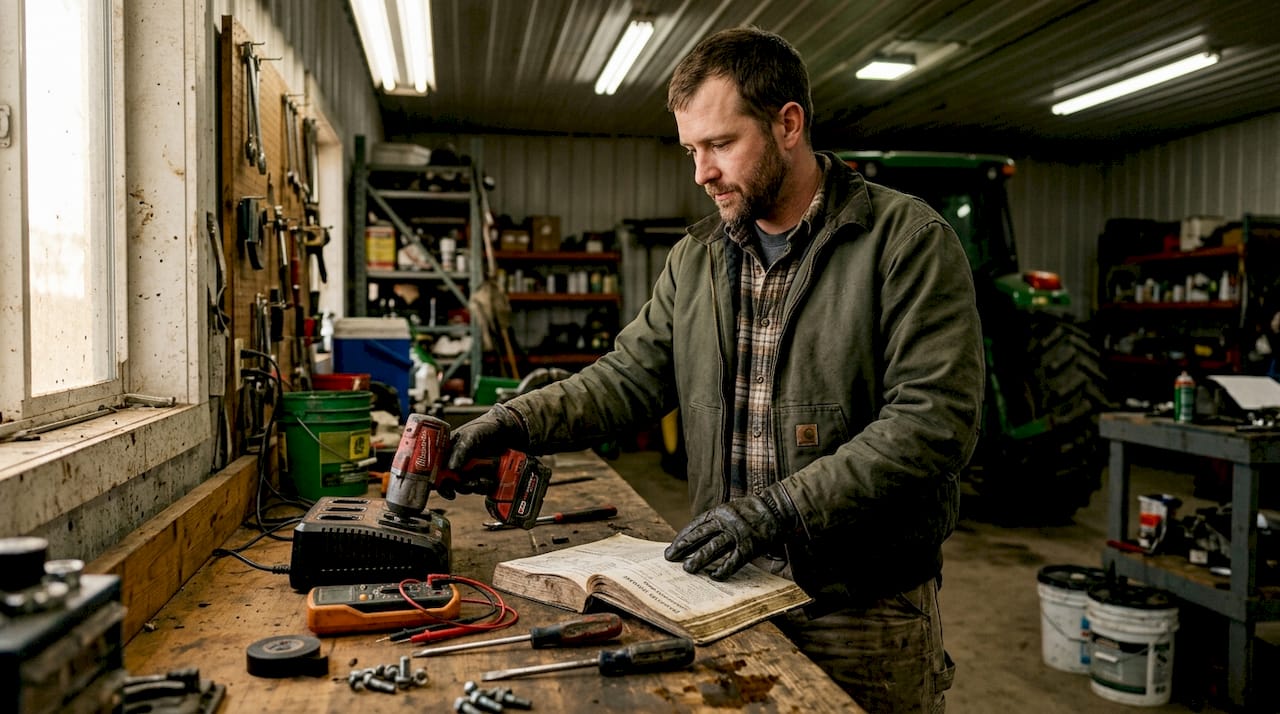
Essential safety gear and field support tools
Tools fix machines. Safety gear protects you. Working alone in a remote field with a hydraulic jack and an angle grinder is genuinely dangerous without the right protective equipment. Simple safety equipment like gloves and goggles dramatically reduces farm injuries, and the cost is minimal compared to a hospital visit.
Every field repair kit should include:
- Heavy-duty work gloves. Not thin garden gloves. You need cut-resistant, grip-enhanced gloves that hold up against metal edges and hot surfaces.
- Protective eyewear. Grinding, drilling, and pressure washing all throw debris. Safety glasses or goggles are non-negotiable.
- Trauma-capable first aid kit. Include bandages, antiseptic, a tourniquet, and burn treatment. Farm injuries can be severe and help may be far away.
- Portable LED work light. Breakdowns do not wait for daylight. A rechargeable LED light with a magnetic base lets you work in any position and any light condition.
- ABC-type fire extinguisher. Fuel leaks and electrical faults can ignite quickly. An ABC extinguisher handles all three common fire types.
- Warning triangle or reflective markers. If you are working on a roadside or near a field entrance, visibility matters for your safety and others.
“Every year, preventable farm injuries cost thousands in lost productivity. The right safety gear is not optional equipment. It is part of the job.”
Review the full agricultural machinery care guide to see how safety practices integrate with your regular maintenance routine.
Quick-reference comparison: Must-have repair tools
After reviewing all essential hand, power, and safety tools, here is an at-a-glance summary to help you organize and prioritize your toolkit. Proper repair tool investment pays for itself in reduced downtime and lower repair expenses over time.
| Tool type | Primary use | Essential feature | Best scenario |
|---|---|---|---|
| Combination wrench set | Bolts and nuts | Metric and imperial sizes | Daily tractor maintenance |
| Locking pliers | Gripping and holding parts | Adjustable jaw lock | Solo field repairs |
| Cordless impact wrench | Fast bolt removal | High torque (400+ Nm) | Wheel and engine work |
| Hydraulic floor jack | Lifting heavy equipment | 5-ton minimum rating | Tire and axle repairs |
| OBD diagnostic scanner | Reading fault codes | Compatible with your tractor brand | Electronic troubleshooting |
| Torque wrench | Precise bolt tightening | Adjustable range | Engine and hub assembly |
| ABC fire extinguisher | Fire suppression | Handles fuel and electrical fires | All field repair situations |
| Portable LED work light | Visibility in low light | Magnetic base, rechargeable | Night or indoor repairs |
Use this table when packing your service trailer or deciding where to spend your next tool budget. The preventive maintenance benefits for Greek farmers are well documented, and a complete toolkit is the starting point.
Situational tips: How to adjust your toolkit for different machinery
A toolkit that works perfectly for a 90-horsepower tractor may leave you short when you are working on a combine or a trailed sprayer. Selecting tools tailored to your equipment prevents unnecessary purchases and ensures you are always ready for the job at hand.
Here is how to adapt your toolkit based on what you operate:
- For tractors: Focus on a full wrench set, a quality torque wrench, a hydraulic jack, and an OBD scanner compatible with your brand. Keep a spare set of common filters and belts alongside your tools.
- For sprayers: Add chemical-resistant gloves, nozzle cleaning tools, and a pressure gauge. Sprayer fittings often use non-standard thread sizes, so carry a set of adapters.
- For combines and harvesters: Prioritize a belt tension gauge, a chain breaker tool, and a bearing puller. These machines have more moving parts and wear components that need specific tools.
- For remote field work: Build a compact kit that fits in a single toolbox or backpack. Include only the highest-priority tools and a basic first aid kit. Weight and portability matter when you are far from your farm.
- For sourcing tools in Greece: Thessaloniki and Kavala have strong agricultural supply networks. For specialty adapters or hard-to-find parts, online platforms like Pexlivanidis offer a wide catalog with delivery across Greece.
The full equipment maintenance guide covers machine-specific maintenance steps that pair well with these toolkit adjustments.
Get the right tools and parts for your farm
Building a solid repair toolkit is only the first step. Keeping your machines running also means having access to quality spare parts when something wears out or breaks. At Pexlivanidis, you will find over 20,000 agricultural machinery parts and accessories, with free shipping across Greece on orders over 100€. Whether you need filters, belts, hydraulic fittings, or specialty components, the inventory covers a wide range of tractor brands and implement types. Explore the full guide to essential machinery parts to understand what your machines need most, and check the maintenance tips guide for expert-backed advice on keeping your equipment in peak condition all season long.
Frequently asked questions
What is the absolute minimum repair toolkit every Greek farmer should have?
At minimum, you need wrenches, pliers, and screwdrivers along with a hammer and basic safety gear to handle common emergency repairs in the field.
How often should I inspect my repair tools for wear or damage?
Inspect your tools every month or before any major repair session. Routine checks for both your machinery and your tools improve reliability and prevent failures at the worst possible moment.
Are power tools necessary for tractor repairs?
Not always, but cordless impact wrenches and diagnostic scanners greatly speed up repairs and help you handle tough bolts and electronic faults that hand tools simply cannot address.
What safety equipment should be part of every field repair kit?
Always include gloves, protective eyewear, a first aid kit, and a fire extinguisher. Gloves and goggles alone dramatically cut the risk of common farm injuries.
How can I organize my repair tools for quick access in the field?
Use foam trays, color-coded handles, or tool rolls to keep items sorted and easy to grab. A well-organized toolbox in your tractor cab or service trailer saves critical minutes during an emergency repair.