

Greek farmers face a harsh reality: post-harvest losses reach 30-42% for fruits and vegetables due to poor logistics. These staggering losses translate directly into reduced income and wasted resources. Agri-logistics offers a systematic approach to managing product flow from your field to the consumer, addressing storage, transportation, and distribution challenges. This guide breaks down what agri-logistics means for your operation, explores proven optimization methods, examines Greek initiatives making a difference, and shows how proper machinery maintenance strengthens your entire supply chain.
Table of Contents
- Key takeaways
- Understanding agri-logistics: scope and significance
- Advanced methodologies for agri-logistics optimization
- Agri-logistics in Greece: initiatives and practical challenges
- Machinery maintenance: a key to efficient agri-logistics in Greece
- Explore expert agricultural machinery care solutions
- What is agri-logistics? Frequently asked questions
Key Takeaways
| Point | Details |
|---|---|
| Scope of agri logistics | Agri logistics covers harvest, storage, processing, and transportation to move products from farm to consumer and reduce waste. |
| Greek farm context | In Greece, geography and seasonality create unique transport and storage challenges that logistics optimization helps overcome while protecting quality and cutting costs. |
| Optimization methodologies | Cold chain management, GIS scheduling, and mixed integer programming help reduce costs and losses for perishable goods. |
| Machinery maintenance impact | Regular maintenance strengthens every link in the supply chain by preventing temperature excursions, delays, and spoilage during handling and transport. |
| Technology and visibility | Real time tracking and sensors provide visibility across the chain enabling proactive problem solving. |
Understanding agri-logistics: scope and significance
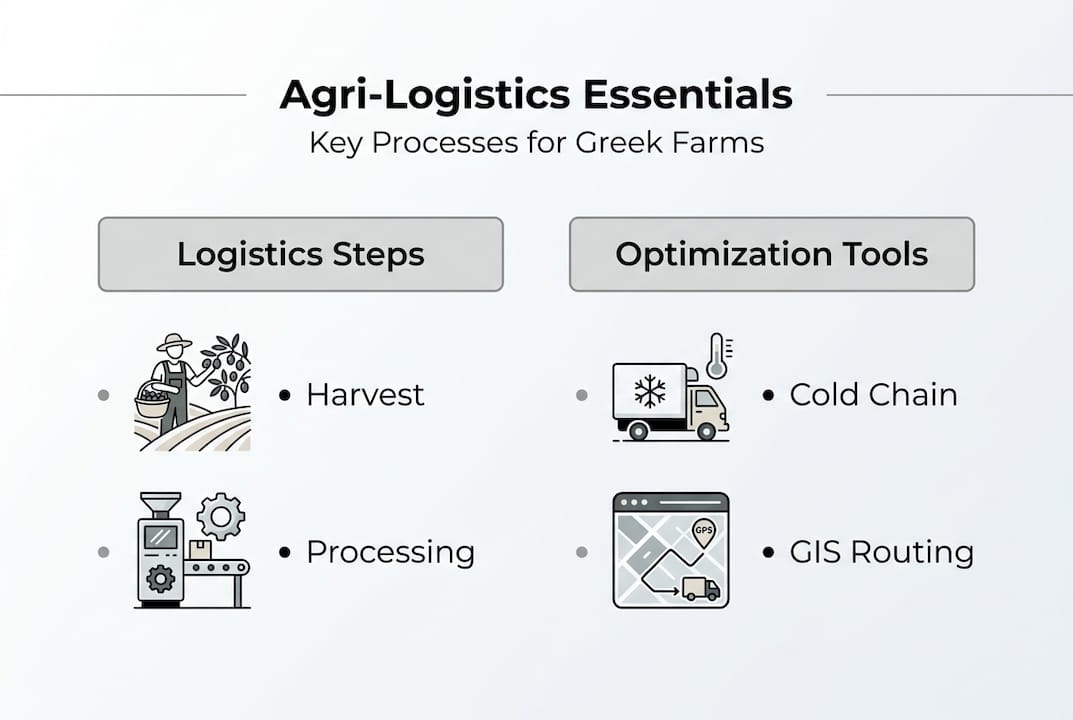
Agri-logistics manages the flow from farm to consumer, covering harvesting, storage, processing, and transportation. This integrated approach minimizes waste and optimizes every stage of your supply chain. For Greek farmers dealing with perishable crops like olives, citrus, and vegetables, efficient logistics determines whether products reach markets at peak quality or spoil en route.
The scope extends beyond simple transportation. You coordinate harvest timing, warehouse capacity, cooling systems, vehicle routing, and delivery schedules. Each component affects the others. A delayed harvest might overwhelm storage facilities. Inadequate cooling during transport ruins days of careful cultivation. Poor route planning increases fuel costs and delivery times.
Modern agri-logistics integrates technology to address these challenges. GPS tracking monitors shipment locations in real time. Temperature sensors alert you to cooling failures before products spoil. Digital platforms connect farmers directly with buyers, reducing intermediary delays. These tools transform reactive problem-solving into proactive supply chain management.
Greek farms benefit particularly from logistics optimization given the country’s geography. Islands and mountainous regions create transportation challenges. Summer heat threatens perishable goods. Limited infrastructure in rural areas complicates distribution. Systematic logistics planning helps you navigate these obstacles while maintaining product quality and controlling costs.
The connection to precision agriculture applications strengthens your competitive position. Data-driven decisions about planting, harvesting, and distribution create efficiency gains throughout your operation. You reduce input costs while improving output quality and market timing.
Key components of effective agri-logistics include:
- Harvest planning that aligns picking schedules with storage capacity and market demand
- Temperature-controlled storage facilities that maintain product quality during holding periods
- Transportation networks optimized for speed, cost, and product protection
- Distribution channels that connect your farm efficiently to wholesale and retail buyers
- Information systems that provide visibility across the entire supply chain
Advanced methodologies for agri-logistics optimization
Cold chain optimization, GIS scheduling, and mixed-integer programming reduce costs and losses for perishable goods. These methodologies transform complex logistics challenges into manageable, data-driven processes. Greek farmers handling temperature-sensitive products gain measurable advantages through systematic application of these approaches.
Cold chain management maintains consistent temperatures from harvest through delivery. You monitor every transition point where temperature fluctuations might occur. Refrigerated storage, insulated transport vehicles, and rapid handling procedures work together. A single weak link compromises the entire chain. Digital temperature logging provides documentation that buyers increasingly require for quality assurance.

GIS-based route scheduling considers multiple variables simultaneously. Distance represents just one factor. You account for road conditions, traffic patterns, delivery time windows, and vehicle capacity. The system calculates optimal routes that minimize fuel consumption while meeting delivery commitments. Real-time adjustments accommodate unexpected delays or urgent orders.
Mixed-integer programming models handle complex decision-making scenarios. You balance competing priorities like minimizing costs, maximizing freshness, and meeting customer requirements. The mathematical models process thousands of possible scenarios to identify the best solution. This approach proves especially valuable during peak harvest periods when logistics capacity becomes constrained.
Big data analytics reveal patterns invisible to manual analysis. You identify which routes consistently perform best, which storage facilities maintain optimal conditions, and which time periods present the greatest challenges. Historical data informs future planning. Predictive models help you anticipate problems before they disrupt operations.
Pro Tip: Implement temperature monitoring at every transfer point in your cold chain. The data helps you identify exactly where quality losses occur, allowing targeted improvements that deliver maximum return on investment.
The table below compares logistics performance metrics with and without optimization technologies:
| Metric | Without Optimization | With Optimization | Improvement |
|---|---|---|---|
| Spoilage Rate | 18-25% | 6-9% | 60-70% reduction |
| Fuel Costs | Baseline | 15-22% lower | Significant savings |
| Delivery Accuracy | 78-82% | 94-97% | Improved reliability |
| Average Transit Time | Baseline | 25-35% faster | Faster delivery |
Integrating these methodologies with preventive maintenance benefits creates compounding advantages. Reliable equipment supports consistent logistics performance. You avoid the cascade of problems that equipment failures trigger throughout your supply chain.
Advanced agri-logistics optimization research continues developing new approaches. Machine learning algorithms improve route predictions. Blockchain technology enhances traceability. Internet of Things sensors provide unprecedented visibility into product conditions during transport.
Agri-logistics in Greece: initiatives and practical challenges
AgriLogistiCluster promotes smarter, greener cross-border supply chains connecting Greek and Italian agricultural regions. This collaborative initiative addresses common challenges through shared resources, knowledge exchange, and coordinated infrastructure development. Greek farmers gain access to expanded markets while improving logistics efficiency.
The clustering approach pools resources among multiple farms and processors. You share transportation capacity, storage facilities, and distribution networks. Individual operations too small to justify dedicated logistics infrastructure benefit from collective capabilities. Costs decrease while service levels improve. The model proves particularly effective for specialty crops with limited individual volumes.
Fourth-party logistics (4PL) providers coordinate these complex networks. Unlike traditional carriers, 4PL companies like Agrologistics manage the entire supply chain on your behalf. They negotiate with carriers, arrange storage, handle documentation, and optimize routing. You focus on farming while specialists handle logistics complexity.
Infrastructure challenges persist despite these initiatives. Rural road quality varies significantly across Greece. Port capacity limitations affect export-oriented operations. Refrigerated storage remains insufficient in some regions. These physical constraints require creative solutions and ongoing investment.
Greek farms also contend with seasonal demand fluctuations that strain logistics capacity. Summer tourist season creates peak demand exactly when heat makes transportation most challenging. Coordinated planning through clustering initiatives helps balance these competing pressures.
Practical impacts on machinery and product flow include:
- Reduced empty return trips through coordinated scheduling among multiple farms
- Improved negotiating power with carriers due to aggregated shipping volumes
- Enhanced access to specialized equipment like refrigerated containers
- Streamlined customs and export documentation for international shipments
- Better market intelligence through shared information networks
The comparison below illustrates performance differences between independent and clustered logistics approaches:
| Factor | Independent Logistics | Clustered Approach | Advantage |
|---|---|---|---|
| Transportation Costs | Full rate per shipment | Shared costs | 30-40% lower |
| Storage Access | Limited options | Pooled facilities | Greater flexibility |
| Market Reach | Local/regional | National/international | Expanded opportunities |
| Technology Investment | Individual burden | Shared infrastructure | Affordable access |
| Negotiating Power | Minimal | Collective strength | Better terms |
Pro Tip: Join local agricultural cooperatives or clustering initiatives even if you maintain independent sales channels. The logistics benefits alone justify participation, and you preserve flexibility in marketing decisions.
Integrating seasonal tractor maintenance with logistics planning ensures equipment readiness during critical periods. Coordinated maintenance schedules prevent breakdowns during peak harvest and distribution times.
Machinery maintenance: a key to efficient agri-logistics in Greece
Seasonal tractor maintenance cuts downtime by 40% and extends machinery lifespan by 30%. These improvements directly support logistics reliability. Equipment failures during harvest create cascading delays throughout your supply chain. Products sit in fields beyond optimal picking time. Storage facilities wait idle while transport schedules slip. Buyers receive late deliveries or products past peak quality.
Preventive maintenance eliminates most unexpected breakdowns. You control when equipment receives attention rather than reacting to failures at the worst possible moments. Scheduled service during off-peak periods costs less and causes minimal disruption. The investment pays for itself many times over through avoided emergency repairs and lost productivity.
Greek farming conditions demand particular attention to specific maintenance areas. Dust infiltration affects air filters and cooling systems. Summer heat stresses hydraulic fluids and engine cooling. Seasonal transitions between crops require equipment configuration changes. Your maintenance program must address these regional factors.
Follow this numbered maintenance checklist to maximize equipment reliability:
- Check and change engine oil according to manufacturer specifications, using appropriate viscosity for Greek climate conditions
- Inspect and replace air filters monthly during dusty summer conditions to prevent engine damage
- Test hydraulic system pressure and examine hoses for wear, replacing components before failures occur
- Verify tire pressure and tread depth, adjusting for different field conditions and load requirements
- Clean and lubricate all grease points, paying special attention to high-stress components
- Inspect electrical systems including battery condition, connections, and lighting functionality
- Test cooling system capacity and check coolant concentration before summer heat arrives
- Examine belts and chains for proper tension and wear, adjusting or replacing as needed
- Verify brake function and adjust as necessary for safe road transport
- Document all maintenance activities to track patterns and predict future service needs
The connection between machinery reliability and logistics performance becomes obvious during harvest. A tractor breakdown delays picking by hours or days. Perishable crops deteriorate in the field. You miss contracted delivery windows. Buyers source from competitors. The financial impact extends far beyond repair costs.
Pro Tip: Maintain a spare parts inventory for components most likely to fail during critical periods. Common items like filters, belts, and hydraulic hoses cost little to stock but prevent catastrophic delays when failures occur.
Comprehensive guidance in the agricultural machinery maintenance guide helps you develop systematic service routines. Understanding equipment requirements prevents both over-maintenance that wastes resources and under-maintenance that risks failures.
Quality parts make maintenance programs effective. Inferior components fail prematurely, negating your preventive efforts. Reliable suppliers providing genuine or equivalent-quality parts ensure maintenance delivers expected results. The tractor maintenance tips resource explains how component quality affects long-term equipment performance.
Explore expert agricultural machinery care solutions
Pexlivanidis provides the expertise and resources Greek farmers need to maintain reliable equipment supporting efficient agri-logistics. Our comprehensive machinery maintenance guide walks you through systematic care routines that prevent costly breakdowns during critical periods. With over 20,000 parts in inventory, we supply the components you need when you need them.
Understanding equipment systems helps you make informed maintenance decisions. Our detailed explanation of agricultural machinery parts covers how components work together and why quality matters. This knowledge empowers you to evaluate service recommendations and select appropriate replacement parts.
Implementing proven maintenance practices protects your logistics capabilities. The machinery maintenance tips guide offers practical advice tailored to Greek farming conditions. You gain strategies that experienced operators use to maximize equipment reliability while controlling maintenance costs. Free shipping on orders over 100€ makes it easy to stock essential spare parts.
What is agri-logistics? Frequently asked questions
How does agri-logistics reduce waste on my farm?
Agri-logistics minimizes waste by coordinating harvest timing with storage capacity and market demand, preventing products from spoiling due to delays. Optimized cold chain management maintains quality during transport. Efficient routing reduces transit time for perishable goods. These systematic approaches cut losses by 60-70% compared to uncoordinated logistics.
What are the main benefits of cold chain optimization for Greek farmers?
Cold chain optimization preserves product quality from harvest through delivery, commanding premium prices for superior goods. You reduce spoilage rates from 18-25% down to 6-9% through consistent temperature control. Documentation of temperature maintenance satisfies buyer quality requirements. The investment pays for itself through reduced losses and higher selling prices.
How often should I schedule tractor maintenance during harvest season?
Schedule comprehensive maintenance before harvest begins, then perform daily inspections during peak operations. Check fluid levels, air filters, and tire pressure each morning. Address any issues immediately rather than deferring until convenient. Weekly detailed inspections during harvest catch developing problems before they cause breakdowns. This intensive schedule prevents the 40% downtime reduction that proper maintenance delivers.
What makes Greek agri-logistics particularly challenging?
Greek geography creates unique obstacles with islands, mountains, and dispersed growing regions complicating transportation. Summer heat threatens perishable goods during peak production periods. Limited rural infrastructure requires creative routing solutions. Seasonal tourism demand coincides with harvest, straining logistics capacity. These factors make systematic planning and clustering initiatives especially valuable for Greek operations.
Can small farms benefit from advanced logistics optimization?
Small farms gain significant advantages through clustering initiatives and cooperative arrangements that provide access to optimization technologies. You share costs of GPS tracking, temperature monitoring, and route planning software. Pooled shipping volumes improve negotiating power with carriers. Fourth-party logistics providers offer sophisticated services at scales appropriate for smaller operations. The key is collaboration rather than individual investment.
How does machinery maintenance connect to supply chain efficiency?
Reliable equipment ensures harvest occurs at optimal times, preventing logistics delays that cascade through your supply chain. Scheduled maintenance eliminates unexpected breakdowns during critical periods. You meet delivery commitments consistently, building buyer confidence. The 30% lifespan extension from proper maintenance reduces capital costs while supporting dependable operations. Equipment reliability forms the foundation of effective agri-logistics.