

Replacing tractor parts constantly is not just expensive — it is a sign that something deeper is being overlooked. Parts durability refers to the ability of tractor components to withstand wear, fatigue, stress, and environmental factors over extended operating hours, ensuring longevity and reliability in agricultural operations. When you understand what drives durability and how to prioritize it, you stop reacting to breakdowns and start preventing them. This guide gives you the knowledge to make smarter parts choices, reduce downtime, and keep your machinery running through every critical season.
Table of Contents
- What is parts durability?
- Why parts durability matters in Greek agriculture
- Key factors that influence durability
- How durability is measured and tested
- Maximizing durability: Practical steps for farmers
- Find the most durable parts and expert support
- Frequently asked questions
Key Takeaways
| Point | Details |
|---|---|
| Durability definition | Durability means a tractor part can withstand wear, fatigue, and stress over many operating hours with minimal failures. |
| Greek environment impact | Dust, rough terrain, and seasonal peaks in Greece make parts durability even more important for farming efficiency and cost savings. |
| Testing and benchmarks | Industrial-grade tractor parts are expected to last up to 5,000 hours or more when tested and maintained properly. |
| Optimize with preventive care | Routine maintenance and choosing OEM parts can extend equipment life by 25–30% compared to neglecting these practices. |
| Smart purchasing matters | Evaluating materials, certifications, and sources helps you select the most durable parts and avoid costly replacements. |
What is parts durability?
Durability is not about finding a part that never fails. It is about choosing components that significantly reduce how often and how badly things go wrong. For tractor operators, that distinction matters every single day.
Parts durability is the ability of tractor components to withstand wear, fatigue, stress, and environmental factors over extended operating hours. In plain terms:
- Wear is the gradual loss of material from surfaces rubbing together, like brake pads or gear teeth.
- Fatigue is what happens when a part is stressed repeatedly over time, even below its breaking point, until it cracks.
- Stress refers to the forces acting on a part during heavy loads, vibrations, or sudden impacts.
High-durability parts handle all three of these challenges better and for longer. The result is fewer unexpected breakdowns and more productive hours in the field.
“Parts durability refers to the ability of tractor components to withstand wear, fatigue, stress, and environmental factors over extended operating hours, ensuring longevity and reliability in agricultural operations.”
When it comes to sourcing, OEM tractor parts are engineered to meet the original design specifications of your machine. That means tighter tolerances, better materials, and longer service life compared to generic alternatives. The benefits of genuine parts go beyond just fit — they include predictable performance and reduced risk of cascading failures where one bad part damages others.
Why parts durability matters in Greek agriculture
Greece’s farming environment is not forgiving. Dusty fields in Macedonia and Thrace, rocky terrain in the Peloponnese, and the intense seasonal push during olive harvest or grain planting all put extreme strain on machinery. Understanding the definition is important, but context matters — here is why durability is critical for Greek farmers like you.
Harsh conditions like dust and terrain in Northern Greece accelerate wear on components like air filters and drivetrains. Seasonal high-intensity use causes more stress than year-round moderate operation, meaning your tractor takes a beating in a short window with little time for recovery.
Here is what that looks like in practice:
- Air filters clog faster in dusty olive groves and grain fields, reducing engine efficiency.
- Drivetrain components wear out sooner on rocky or uneven terrain.
- Hydraulic seals and hoses degrade faster under temperature swings common in Greek summers.
- A breakdown during harvest can cost you far more than the price of a quality part.
Non-OEM parts fail 25-30% sooner than genuine or OEM alternatives under these conditions. That is not a small margin. During a two-week harvest window, a single failure can mean lost crop, emergency repair costs, and missed deadlines.
Choosing genuine spare parts is one of the most direct ways to protect your operation. Pairing that with a plan to extend tractor life through smart maintenance gives you a real competitive edge.
Pro Tip: Always match your parts selection and maintenance schedule to your specific regional conditions. A farmer in Crete dealing with sandy soil has different needs than one in Thessaly working heavy clay. One-size-fits-all maintenance is a shortcut that costs you later.
Key factors that influence durability
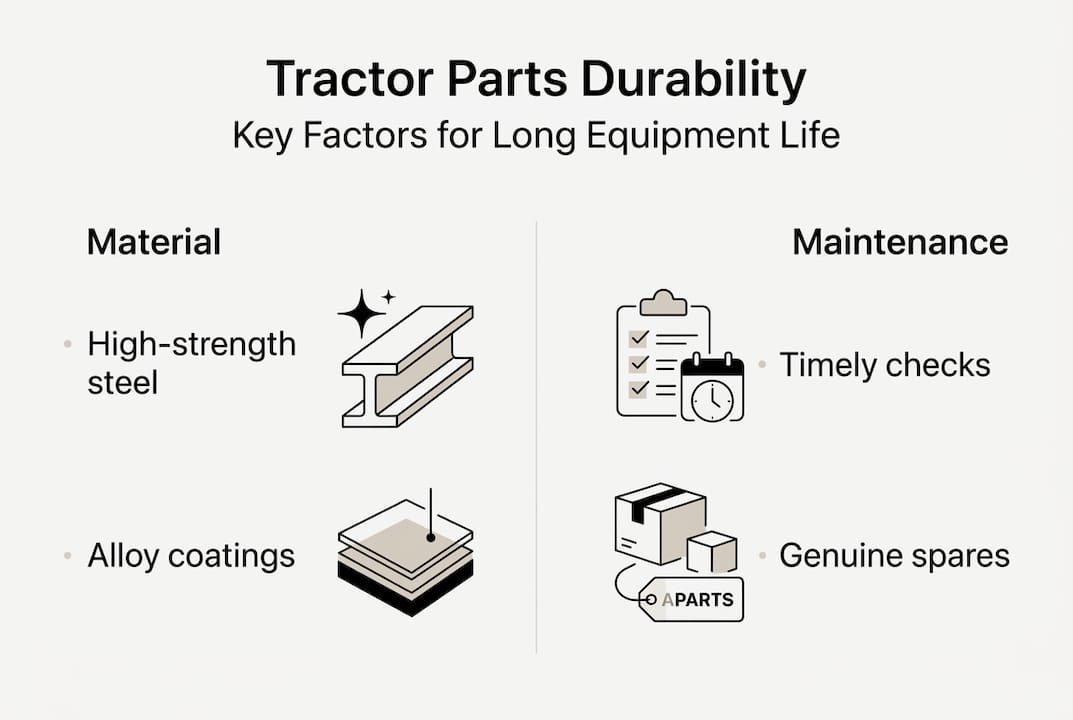
Not all parts are built the same, and the gap between a high-durability component and a standard one often comes down to three things: materials, manufacturing precision, and engineering standards.
Material selection — such as ASTM A572 Grade 50 high-strength steel for frames — directly resists torsional stress and fatigue. Precise tolerances and adherence to standards like ASABE ensure structural integrity under heavy-duty use. Here is how high-durability parts compare to standard alternatives:
| Feature | High-durability parts | Standard parts |
|---|---|---|
| Material | High-grade steel, certified alloys | Standard alloys, variable quality |
| Manufacturing tolerance | Tight, precision-engineered | Wider, less consistent |
| Standards compliance | ASABE, OECD, SAE certified | Often uncertified |
| Expected service life | 3,000–5,000+ hours | 1,500–2,500 hours |
| Failure risk under stress | Low | Moderate to high |
Before you purchase a part, run through these steps to assess its durability:
- Check material specs. Ask for the material grade or certification. High-strength steel designations like ASTM A572 are a good sign.
- Verify standards compliance. Look for ASABE, OECD, or SAE markings, which indicate the part has been tested for agricultural use.
- Confirm manufacturing tolerances. OEM parts list tolerance specs. Tight tolerances mean better fit and less vibration-induced wear.
- Research the supplier. Reputable suppliers stand behind their parts with warranties and technical support.
- Compare service life data. Ask for operating hour benchmarks or consult choosing OEM tractor parts resources to compare expected lifespans.
Combining quality parts with a solid preventative maintenance for tractors program is where you get the most out of your investment.
How durability is measured and tested
Once you know which factors matter, how do manufacturers — and you — actually measure durability? That is where rigorous testing comes in.
Testing methodologies involve fatigue life prediction using finite element analysis (FEA), rain flow counting for load spectra, Miner’s rule, and field-correlated lab testing like Nebraska Tractor Test Lab procedures. In plain language, FEA uses computer modeling to simulate stress on a part before it is ever built. Miner’s rule calculates how cumulative small stresses add up to eventual failure. These are not just academic exercises — they directly predict how long a part will last in your field.
Field validation adds another layer. The Nebraska Tractor Test Lab, one of the most respected testing bodies in the world, puts tractors through standardized performance and durability evaluations. The results give you real numbers to compare.
| Tractor/part grade | Target operating hours before major overhaul |
|---|---|
| Industrial-spec machinery | 3,000–5,000 hours |
| Standard grade | 1,500–2,500 hours |
| Total tractor life (average) | 4,000–10,000 hours |
Empirical benchmarks show that industrial-spec machinery targets 3,000–5,000 operating hours before major overhaul, while standard grade reaches 1,500–2,500 hours. Keep in mind that lab results are based on controlled conditions. Your actual results may vary depending on soil type, altitude, and how hard you push the machine during peak season.
“Preventive maintenance can increase part life by up to 30%, making scheduled upkeep one of the highest-return investments a farmer can make.”
For practical guidance on applying this to your own equipment, the maintenance steps to extend tractor life resource is a solid starting point.
Maximizing durability: Practical steps for farmers
You know what to look for and how durability is rated — here is how to take control and improve real-world performance on your own farm.
Genuine parts and preventive maintenance tailored to Greek conditions minimize downtime and costs, with OEM parts delivering 25% fewer failures than non-OEM alternatives. That number adds up fast across a full season.
Here is a practical checklist to maximize durability across your fleet:
- Buy OEM or genuine parts from verified suppliers. The upfront cost is higher, but the total cost of ownership is lower.
- Follow the manufacturer’s maintenance schedule without skipping intervals, especially during high-intensity seasons.
- Inspect air filters weekly during dusty operations. A clogged filter stresses the engine and accelerates wear on multiple components.
- Check drivetrain components before and after each major work cycle, particularly on rocky or uneven terrain.
- Lubricate on schedule. Proper lubrication reduces friction-based wear dramatically and is one of the cheapest forms of protection.
- Store parts correctly. Humidity and temperature swings degrade seals and rubber components even before installation.
- Track your failures. Keep a simple log of which parts fail, when, and under what conditions.
The last point is more powerful than it sounds. Over one or two seasons, your log will show you exactly which brands and part types hold up best for your specific conditions. That data is worth more than any catalog description.
Pro Tip: Track every part failure with the date, operating hours, and conditions. After two seasons, you will have a clear picture of which suppliers and part types deliver real durability for your farm — and which ones just look good on paper.
Pairing smart purchasing with a consistent plan to extend tractor life and why use genuine spare parts practices gives you a system, not just a habit. Systems are what keep equipment running year after year.
For a structured approach to upkeep, preventative maintenance for tractors covers the key intervals and tasks that protect your investment across every season.
Find the most durable parts and expert support
Ready to maximize your equipment’s potential and minimize costly downtime? Pexlivanidis carries an inventory of over 20,000 agricultural machinery parts built to handle the demands of Greek farming conditions. Whether you need OEM-grade components for a specific tractor model or want guidance on the right parts for your terrain and work cycle, the team is equipped to help. Browse detailed machinery maintenance tips to pair your parts choices with the right upkeep practices. For direct access to the full range of tractor part solutions, free shipping applies to orders over 100€ within Greece, making it easy to stock up before the season starts.
Frequently asked questions
What is the typical lifespan of durable tractor parts?
Industrial-grade parts typically last 3,000–5,000 operating hours before a major overhaul, while standard-grade components reach 1,500–2,500 hours when maintained properly.
How can I tell if a part is genuinely durable?
Look for material certifications, compliance with standards like ASABE or OECD, and buy from suppliers who offer OEM or genuine parts with documented specs and warranties.
Does preventive maintenance really extend the life of parts?
Yes. Preventive maintenance can extend tractor part life by approximately 30%, making it one of the most cost-effective investments you can make in your equipment.
Are non-OEM parts really less durable?
Non-OEM parts fail 25–30% sooner than genuine or OEM alternatives under typical Greek farm conditions, which is a significant risk during high-intensity seasonal work.