

TL;DR:
- Proper seasonal tractor maintenance prevents costly breakdowns and ensures timely harvests.
- Check and replace fluids, inspect tires, battery, and components based on Greece’s regional climate.
- Using OEM parts and sourcing locally helps reduce downtime and extends tractor lifespan.
Greek farmers know that the gap between a productive season and a costly breakdown often comes down to what happens before the first field run. From the frost-heavy winters of Macedonia to the scorching summers of the Peloponnese, your tractor faces wildly different demands across the calendar year. Skipping preparation steps or using the wrong parts doesn’t just risk a breakdown. It risks your entire harvest window. This guide walks you through every critical step, from readiness checks to parts sourcing, so you can head into any season with confidence and keep downtime where it belongs: at zero.
Table of Contents
- How to assess your tractor’s seasonal readiness
- Engine and fluid essentials: oil, coolant, and hydraulic systems
- Tire, undercarriage, and battery preparation for Greece’s seasons
- Choosing and sourcing essential parts: OEM vs non-OEM in Greece
- Our take: what most guides miss about Greek tractor preparation
- Ready to optimize your tractor for every season?
- Frequently asked questions
Key Takeaways
| Point | Details |
|---|---|
| Check tractor readiness | Assess your tractor’s fluids, battery, and tires before every season to prevent costly downtime. |
| Prioritize manufacturer-recommended fluids | Use the correct oil, coolant, and hydraulic fluid for Greece’s climate for optimal performance. |
| Choose OEM parts for reliability | OEM parts lower the risk of failure and downtime, especially in demanding Greek terrains. |
| Source parts locally | Local suppliers provide faster access to necessary parts and help keep your operations on schedule. |
How to assess your tractor’s seasonal readiness
Before you turn the key, you need a clear picture of what condition your tractor is actually in. Many operators assume that if the machine ran fine last season, it’s ready to go again. That assumption is expensive. Seasonal shifts create new stress on fluids, electrical systems, and rubber components, and what worked in October may fail you in February.
Start with a structured walkthrough of these core systems:
- Fluids: Check engine oil, coolant, hydraulic fluid, and brake fluid levels and condition. Dark, gritty oil or cloudy coolant are immediate red flags.
- Battery: Test voltage and inspect terminals for corrosion. Cold winters in northern Greece can drain a weak battery overnight.
- Tires: Look for cracking, uneven wear, and pressure loss. Rocky terrain in mountain regions accelerates sidewall damage.
- Electrical system: Check all lights, sensors, and wiring harnesses for damage from rodents or moisture.
- Filters: Air, fuel, and oil filters should be inspected and replaced if there’s any doubt. A clogged air filter alone can raise fuel consumption by up to 10%.
Greece’s climate isn’t uniform, and your checklist shouldn’t be either. In Thessaloniki or Kozani, winter preparation means flushing cooling systems with antifreeze rated for local frost, battery testing and protection, and engine oil changes to prevent freeze damage. In Crete or the Aegean islands, summer heat is the bigger enemy, stressing cooling systems and hydraulic seals in different ways.
“A tractor that sat idle through winter without preparation is not resting. It’s deteriorating.” Use your seasonal tractor maintenance guide to build a region-specific checklist you can run through every year.
Pro Tip: Print out your tractor maintenance checklist and keep it in the cab. Running through it physically, item by item, catches things a quick visual scan will miss.
Red flags that require immediate action before first use include milky engine oil (a sign of coolant contamination), a battery that won’t hold a charge above 12.4 volts, or any hydraulic leak around fittings and cylinders.
Engine and fluid essentials: oil, coolant, and hydraulic systems
Once you’ve identified what needs attention, the next step is addressing the tractor’s engine and critical fluids. This is where most of the real seasonal damage either gets prevented or ignored.
Here’s the order of operations for fluid maintenance:
- Drain and flush the cooling system. Use an antifreeze mix rated for the lowest temperatures in your area. For northern Greece, that means a mix capable of handling temperatures below minus 15 degrees Celsius.
- Change the engine oil. Select the correct viscosity grade for the season. A 15W-40 works well in warm months, but a 10W-30 or 5W-30 is better suited for cold starts in winter. Always follow your manufacturer’s specification.
- Inspect and replace the oil filter. Changing oil without replacing the filter is like putting clean water through a dirty pipe.
- Check hydraulic fluid level and condition. A hydraulic fluid change every 6 months maintains pressure and prevents leaks, especially under peak workloads like harvest or deep tillage.
- Bleed and check brake fluid. Moisture absorption over time lowers the boiling point and reduces braking reliability.
Pro Tip: When choosing tractor oil, don’t just grab the cheapest option at the co-op. Cross-reference the viscosity grade with your tractor’s manual and the expected temperature range for the next three months.
| Fluid | Change interval | Key risk if skipped |
|---|---|---|
| Engine oil | Every 250 hours or seasonally | Engine wear, overheating |
| Coolant/antifreeze | Every 2 years or seasonally | Freeze damage, corrosion |
| Hydraulic fluid | Every 6 months | Pressure loss, seal failure |
| Brake fluid | Annually | Reduced braking performance |
Skipping these steps in Greece’s conditions isn’t just a maintenance oversight. It’s a gamble with your equipment investment. A seized engine or blown hydraulic pump during harvest can cost you far more than a full fluid service. Review your tractor maintenance guide to see how consistent fluid care can extend your tractor’s lifespan by up to 30%.
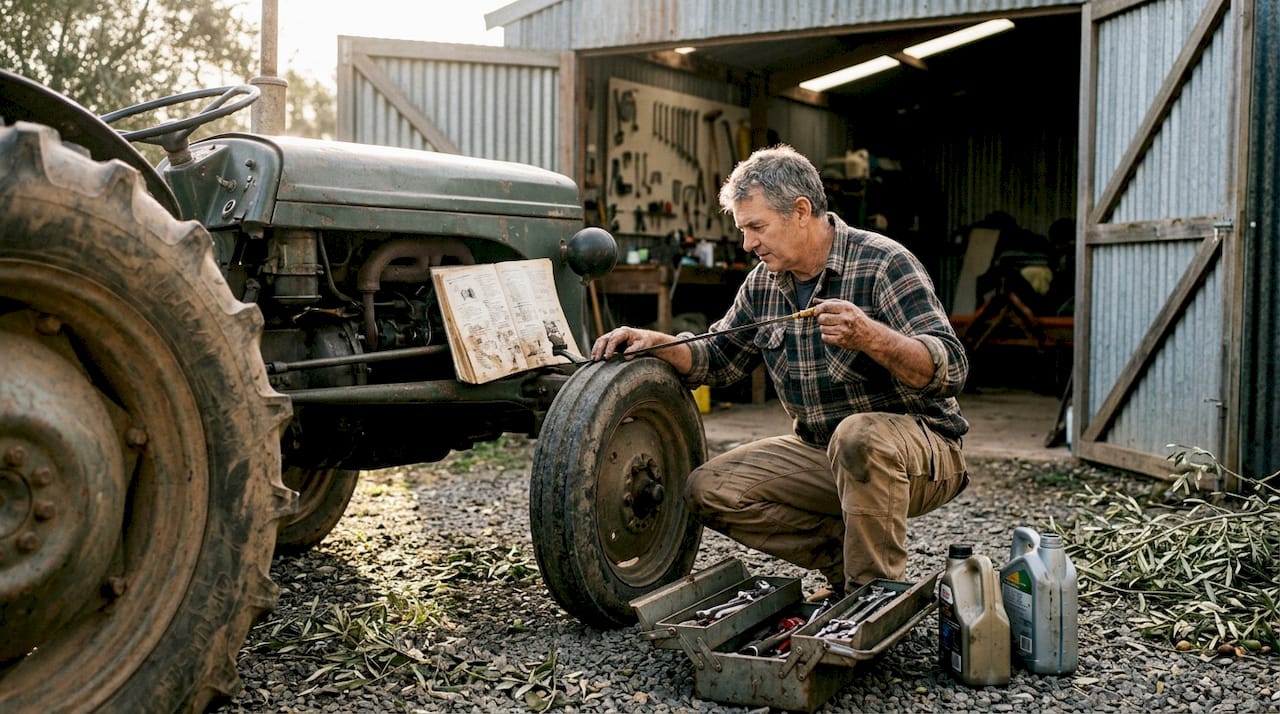
Tire, undercarriage, and battery preparation for Greece’s seasons
With fluids handled, it’s time to ensure your tractor’s key components, tires, undercarriage, and battery, are up to the job. These are the parts that take the most physical punishment from Greece’s varied terrain.
For tires, run through this inspection list before each seasonal start:
- Check tread depth. Agricultural tires should have at least 20mm of tread for effective field traction.
- Inspect sidewalls for cracking or bulging, especially after a dry summer when rubber degrades faster.
- Measure inflation pressure cold, before the tractor has been running. Incorrect pressure causes uneven wear and soil compaction.
- Look for embedded stones or debris in the tread that can cause slow punctures.
As noted in regional tractor care research, high-frost areas in northern Greece need extra coolant service, and rugged terrain stresses tires and undercarriage far more than flat lowland fields. If you’re working on rocky hillsides in Epirus or Thessaly, inspect your undercarriage every 50 operating hours, not just seasonally.
“Your tires are the only part of the tractor actually touching the ground. Treat them accordingly.”
For the battery, follow this sequence each season:
- Test resting voltage with a multimeter. Anything below 12.4 volts under no load needs attention.
- Check terminals for white or blue corrosion and clean with a baking soda solution if needed.
- If the tractor sat unused for more than 60 days, use a smart charger to recondition the battery before starting.
- In northern Greece winters, consider a battery insulation wrap to prevent cold-soak discharge.
| Tire type | Best use case | Weakness |
|---|---|---|
| R1 (agricultural lug) | Wet soil, tillage | Poor on hard surfaces |
| R3 (turf) | Orchards, vineyards | Limited traction in mud |
| R4 (industrial) | Hard ground, roads | Less grip in soft soil |
Refer to your tractor maintenance guide for undercarriage inspection points specific to your tractor model.
Choosing and sourcing essential parts: OEM vs non-OEM in Greece
Getting your tractor road-ready is more than checks. It’s about making the right parts choices and knowing where to source them. This decision directly affects how long your repairs last and how quickly you can get back to work.
For each season, these are the mission-critical parts to have on hand or already installed:
- Filters: Air, oil, fuel, and hydraulic filters. These are consumables that should be replaced on a fixed schedule, not when they visibly fail.
- Belts and drive components: Fan belts, alternator belts, and PTO-related belts crack under temperature stress. Replace any belt showing glazing or fraying.
- Spark plugs or glow plugs: Depending on your engine type, these directly affect cold starts and fuel efficiency.
- Seals and gaskets: Hydraulic and coolant seals are the first to fail after temperature cycling.
Now, the OEM versus non-OEM question. OEM stands for Original Equipment Manufacturer, meaning parts made to the exact specifications of your tractor’s brand. Non-OEM, or aftermarket parts, are made by third parties and vary widely in quality. Following manufacturer guidelines over ad-hoc repairs and choosing OEM parts helps you avoid a 15% higher failure risk that comes with lower-quality aftermarket alternatives.
Pro Tip: Before ordering any part, check our OEM parts guide to understand which components are most critical to source from the original manufacturer and where quality aftermarket options are acceptable.
In the Greek market, supply chain delays are a real operational risk. If a non-OEM part fails during olive harvest or wheat cutting, waiting a week for a replacement can mean losing the entire crop window. Choosing OEM tractor parts from a local supplier with stock on hand is the safest strategy for minimizing that risk.
Our take: what most guides miss about Greek tractor preparation
Most tractor maintenance guides are written for a generic European or North American farmer. They cover the basics well enough, but they completely miss the realities of farming in Greece. The terrain diversity alone, from the wetlands of the Axios Delta to the rocky slopes of the Zagori, means that a single checklist approach will always leave gaps.
What we’ve seen consistently is that farmers who treat seasonal preparation as a fixed routine, same time each year, same trusted supplier, same quality parts, lose far less time to breakdowns than those who approach it reactively. Reactive maintenance in agriculture isn’t just more expensive. It’s operationally dangerous because your window to act is always narrow.
The other thing most guides ignore is the supply reality. Local suppliers like Pexlivanidis provide quick access to the right parts, which is crucial when timing is everything in agriculture. An online order from a distant warehouse might save you a few euros on a filter, but if it takes five days to arrive during a critical work period, that saving evaporates fast.
Our honest advice: build your seasonal prep around a cut downtime guide that accounts for your specific region, your specific machine, and a supplier you can call when something unexpected comes up.
Ready to optimize your tractor for every season?
Having covered the critical how-tos and unique challenges of Greek tractor preparation, the next step is making sure you have the right parts before the season starts, not after the first breakdown. At Pexlivanidis, we carry over 20,000 agricultural machinery parts with free shipping across Greece for orders over 100€. Browse our full tractor parts essentials catalog to stock up on filters, belts, fluids, and more. For a broader service strategy, our maintenance tips guide gives you a practical framework for keeping your equipment running season after season. Order early, order right, and head into every season prepared.
Frequently asked questions
How often should I change hydraulic fluid in my tractor for Greek conditions?
Hydraulic fluid should be changed every six months to maintain proper pressure and prevent leaks, especially under peak seasonal workloads like harvest or deep tillage.
What are the most important winterization steps for tractors in northern Greece?
Flush the cooling system with antifreeze rated for local frost, protect and test your battery, and change the engine oil to a lower-viscosity grade to prevent cold-weather freeze damage.
Is it worth paying extra for OEM tractor parts versus aftermarket options?
OEM parts reduce failure risk by up to 15% compared to non-OEM alternatives, making them a safer and more cost-effective long-term investment for Greek agricultural conditions.
Where can I find reliable replacement parts quickly in Greece?
Local suppliers like Pexlivanidis offer immediate access to OEM and quality parts across Greece, which is essential for minimizing downtime during critical harvest and planting windows.