

TL;DR:
- Proper fluid selection and maintenance schedules prevent damage and reduce repair costs.
- Using genuine parts decreases failure risk and minimizes machinery downtime.
- Regular diagnostics and region-specific preventive maintenance extend equipment lifespan and performance.
A single overlooked repair mistake during harvest season can cost you days of downtime, lost yield, and repair bills that spiral far beyond the original problem. Greek farmers face unique pressures: dusty northern plains, scorching summers, and tight seasonal windows where every hour of uptime counts. The good news is that most catastrophic machinery failures trace back to a small set of repeatable errors. Avoid them consistently, and you extend equipment life, reduce costs, and keep your operation running when it matters most. This article walks you through the four most damaging repair mistakes and exactly how to fix each one.
Table of Contents
- Using incorrect fluids and over-servicing
- Using non-genuine or misidentified parts
- Skipping diagnostics and proper disassembly
- Neglecting local conditions and preventive maintenance
- Our experience: The real cost of ‘good enough’ repairs in Greek farming
- Get the right parts, advice, and support for reliable repairs
- Frequently asked questions
Key Takeaways
| Point | Details |
|---|---|
| Choose correct fluids | The wrong oil or fuel damages machinery and raises costs, so always use manufacturer-recommended types. |
| Always use genuine parts | Non-genuine or incorrect parts cause more breakdowns and extend repair times. |
| Don’t skip diagnostics | Thorough diagnosis helps uncover root problems and prevents repeat repairs. |
| Adapt to local conditions | Preventive care and preparation for Greece’s dust and frost climates cut downtime and prolong equipment life. |
Using incorrect fluids and over-servicing
Fluids are the lifeblood of any tractor or agricultural machine. Get them wrong, and you create invisible damage that compounds quietly until something fails at the worst possible moment. Wrong oil viscosity damages components and can increase repair costs by 10%, and that figure does not include the cost of lost working days.
Using the wrong coolant is equally damaging. Many operators substitute whatever is available locally without checking the specification. Mixing coolant types causes chemical reactions that corrode aluminum components inside the engine block. Using non-diesel fuel in diesel engines, even briefly, strips injector lubrication and accelerates wear on precision-machined surfaces.
Over-servicing is a less obvious but real problem. Changing oil too frequently disrupts the protective film on engine seals and gaskets, causing them to dry out and crack faster than normal. More changes also means more opportunities to introduce contaminants during the process. Following peak performance maintenance schedules based on manufacturer specifications, not guesswork, is the smarter approach.
Common fluids, correct specs, and recommended intervals
| Fluid | Correct specification | Recommended interval |
|---|---|---|
| Engine oil | SAE 15W-40 (check manual) | Every 250 operating hours |
| Coolant | OAT or HOAT as specified | Every 2 years or 2,000 hours |
| Hydraulic fluid | ISO VG 46 or 68 | Every 1,000 hours |
| Transmission fluid | Manufacturer-approved grade | Every 500 hours |
| Diesel fuel | EN 590 standard | Fresh, clean, filtered |
Signs you may be using the wrong fluid:
- Unusual engine noise or rough idling shortly after a fluid change
- Seals or gaskets showing premature cracking or weeping
- Overheating that cannot be explained by cooling system blockage
- Hydraulic system responding sluggishly or inconsistently
- Milky or discolored oil indicating contamination or coolant mixing
Pro Tip: Always consult the manufacturer’s service schedule for fluid change intervals, not just the hours on the meter. Operating in dusty Greek conditions may require more frequent air filter checks, but fluid intervals should follow the spec sheet unless contamination is detected. Our routine checks guide covers this in detail.
With fluids and lubricants setting the foundation, the next category involves a mistake that multiplies downtime:
Using non-genuine or misidentified parts
Even with the right fluids, your next vulnerability lies in parts compatibility. Fitting an incorrect or non-genuine part feels like a solution in the moment, but it often creates a new problem that is harder to diagnose than the original one.
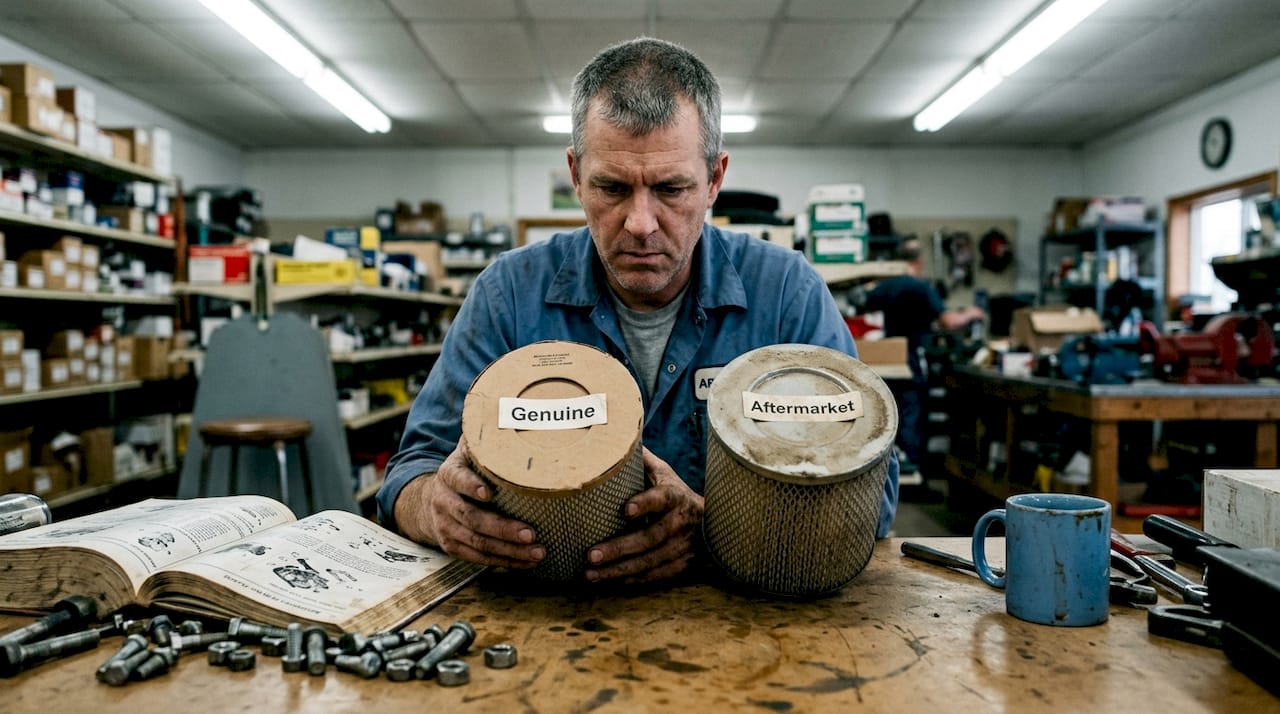
Non-genuine parts carry a 30% higher risk of premature failure, leading to repeated repairs and extended downtime during critical work periods. The issue is not just quality. Misidentified parts, even good-quality ones, can have slightly different tolerances that cause seals to leak, bearings to wear unevenly, or hydraulic circuits to lose pressure.
The cost comparison between genuine and aftermarket parts is more nuanced than it first appears:
Genuine vs. aftermarket parts comparison
| Factor | Genuine OEM parts | Generic aftermarket |
|---|---|---|
| Upfront cost | Higher | Lower |
| Expected service life | Full rated life | Often 40-60% of rated life |
| Failure rate | Baseline | Up to 30% higher |
| Fit and tolerance | Exact | Variable |
| Downtime risk | Low | Moderate to high |
| Total cost over 3 seasons | Lower | Often higher |
Symptoms that suggest you may have fitted incorrect parts:
- Seals leaking immediately or within a few hours of repair
- Unusual vibration or noise from a recently repaired assembly
- Recurring failures in the same location after multiple repairs
- Bolts or fittings that do not seat correctly or require excessive force
- Hydraulic or electrical systems behaving erratically after a parts swap
Understanding the genuine parts benefits goes beyond just quality. It is about reducing the total number of repairs per season and keeping your machine in the field.
Pro Tip: Sourcing genuine parts locally in Greece can cut delivery time from 14 to 21 days down to just 3 to 7 days. During planting or harvest, that difference can mean the gap between a minor delay and a lost crop.
Once parts are selected, thorough diagnostics must come next to ensure repairs succeed:
Skipping diagnostics and proper disassembly
Inadequate diagnostics and skipping systematic disassembly during repairs cause improper fixes and cascading failures. This is the most frustrating category because the machine gets repaired, returned to service, and then fails again within days or weeks.
The root cause is almost always the same: the operator fixed the symptom, not the problem. A leaking hydraulic cylinder gets a new seal, but nobody checks why the seal failed in the first place. A worn bearing gets replaced, but the shaft alignment that caused the wear goes unexamined.
Diagnostic checks every operator should complete before starting a repair:
- Read and record any error codes from the tractor’s onboard diagnostic system
- Perform a visual inspection of the affected system and surrounding components
- Run a leak test on hydraulic and fuel circuits before disassembly
- Check for heat signatures using an infrared thermometer on bearings and housings
- Inspect all fasteners and mounting points for looseness or corrosion
- Review the repair history log for recurring issues in the same area
Systematic disassembly matters just as much as the diagnostic step. Rushing through disassembly means small components get lost, mating surfaces get scratched, and the sequence of reassembly becomes unclear. Photograph each stage. Label every part. Keep fasteners organized by location.
“Overlooking bearing condition is one of the most common sources of repeat field failures. An infrared thermometer costs very little but can identify a bearing running 15 to 20 degrees above normal before it seizes. Documenting every repair also reveals patterns that single-incident thinking misses entirely.” See combine maintenance techniques for more on systematic inspection approaches.
Our maintenance tips guide includes step-by-step disassembly checklists for common tractor systems that can help you build this habit quickly.
The last critical mistake is one of mindset, ignoring Greece’s farming environment and ongoing preventive maintenance:
Neglecting local conditions and preventive maintenance
Greece’s agricultural regions are not kind to machinery. Northern plains generate heavy dust loads that clog air filters in a fraction of the time expected under standard conditions. Coastal humidity accelerates corrosion. Winter frost in highland areas stresses hydraulic seals and fuel systems that were not properly winterized.
Key statistic: Preventive maintenance cuts equipment downtime by 40% and extends machine life by 30%. That is not a marginal improvement. Over five seasons, it represents a fundamentally different financial outcome for your operation.
Preventive tasks specifically suited to Greek conditions:
- Check and clean air filters every 50 hours during dusty harvesting periods
- Inspect hydraulic seals biannually, especially before and after summer heat
- Flush and refill coolant systems before winter in frost-prone regions
- Lubricate all grease points more frequently during high-dust field work
- Drain and replace fuel filters before storage to prevent microbial growth
- Inspect tire condition and pressure before each season change
The financial math is stark. Reactive repairs cost 3 to 5 times more than preventive maintenance, and 70% of breakdowns are entirely preventable with consistent routines. Skipping a scheduled filter change to save an hour today can mean three days of downtime and an emergency parts order next week.
Adapting your maintenance schedule to local conditions is not optional. It is the single most cost-effective decision you can make. The care guide for Greece and our preventive maintenance benefits resource both offer region-specific schedules you can implement immediately.
Our experience: The real cost of ‘good enough’ repairs in Greek farming
After decades working alongside Greek farmers and mechanics across Thessaloniki, Kavala, and the surrounding regions, one pattern stands out clearly. Operators who treat repairs as a quick fix to get back in the field almost always face a bigger breakdown within one or two seasons. The machine does not forget a shortcut.
What surprises many farmers is how small the initial savings actually are. Skipping a diagnostic step saves maybe 30 minutes. Using a generic part saves a few euros. But the compounding effect of these decisions, especially in Greece’s demanding dust and heat, turns minor shortcuts into major failures at the worst possible time.
The operators who consistently outperform their peers share one habit: they treat maintenance as an investment, not an expense. They document repairs, use genuine parts, and follow preventative maintenance for tractors schedules without cutting corners. Over multiple seasons, their repair bills are lower, their yields are higher, and their machines last significantly longer. The math is simple. The discipline is the hard part.
Get the right parts, advice, and support for reliable repairs
If you are ready to leave costly breakdowns behind, here is your next step. At pexlivanidis.com, we stock over 20,000 genuine agricultural machinery parts with free shipping across Greece on orders over 100€. Whether you need to identify the right component or build a full preventive maintenance schedule, our resources are built for Greek conditions and real farm demands. Browse the full breakdown of types of machinery parts, follow our maintenance tips guide for step-by-step routines, or go directly to shop genuine parts and get what you need delivered fast. Your machinery works hard. Give it the support it deserves.
Frequently asked questions
What is the most common repair mistake made by Greek farmers?
Using non-genuine or mismatched parts is the most common mistake, carrying a 30% higher risk of repeat failures and significantly increasing machinery downtime during critical seasons.
How does preventive maintenance help reduce breakdowns?
Consistent preventive maintenance cuts downtime by 40% and extends machine life by 30%, delivering compounding savings across multiple seasons compared to reactive repair habits.
Why is using the correct fluid so important in machinery repair?
Incorrect fluids damage components and raise repair costs by 10%, while excessive oil changes can harm seals and introduce contamination during the service process.
How can I ensure I’m choosing the right spare parts for my tractor?
Always cross-reference your equipment manual and work with local suppliers who stock genuine parts. Local genuine parts reduce delivery time in Greece from 14 to 21 days down to 3 to 7 days, which matters enormously during peak season.